
You used to fill up every 10 days. Now it’s every 7. You haven’t changed your driving. Same commute, same supermarket runs, same school pickups. Something has changed, and it’s costing you real money — roughly $400 a year in extra fuel for a typical 10 percent efficiency drop on a small SUV.
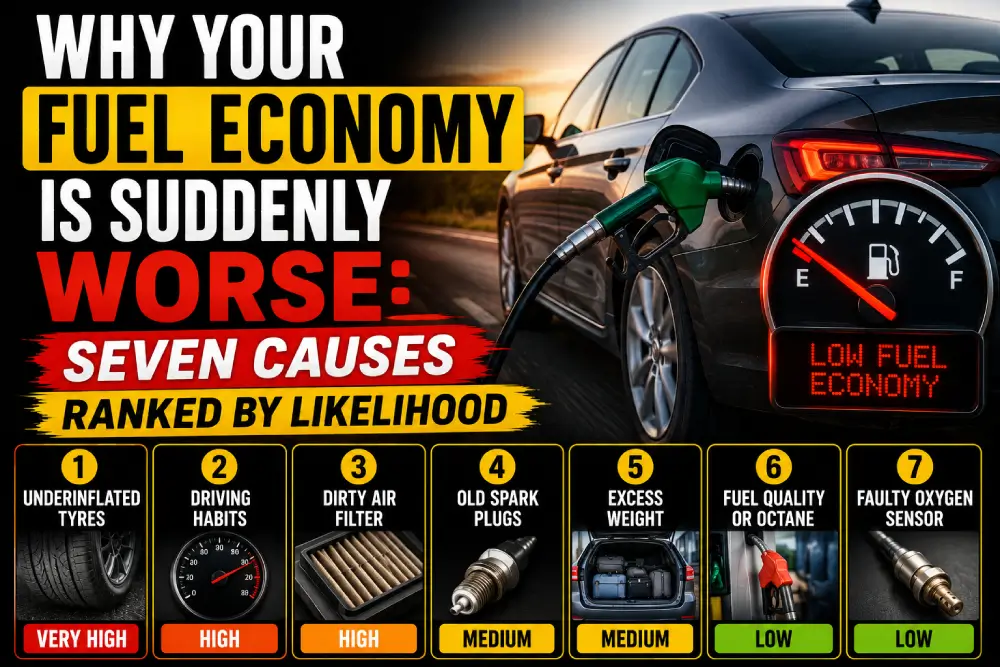
The good news is that a sudden fuel economy decline almost always has a specific, identifiable cause. The bad news is that some causes are cheap to fix and some aren’t. Here are the seven, ordered by how often each one turns out to be the answer in a workshop diagnosis.
1. Tyre pressures dropping (35 percent of cases)
The single most common cause is also the cheapest to fix.
Tyres lose pressure gradually through the rubber itself, faster when ambient temperatures drop, and faster still when tyres get older. A tyre that was at 36 PSI three months ago might be at 30 PSI now. That 6 PSI drop adds 4 to 8 percent to fuel consumption depending on driving style.
Check all four tyres cold (before driving for the day) against the manufacturer’s specification on the door jamb placard, not the maximum number on the sidewall. Adjust to spec. Drive a tank to verify the difference.
Cost: Free at any service station with a working air pump.
2. Air filter blocked (15 percent)
A choked air filter starves the engine of the air it needs for efficient combustion. The engine compensates by running richer (more fuel per air molecule), which produces visible black smoke under hard acceleration on diesels and a fuel smell on petrols.
Air filters are 20,000 to 40,000 km consumables. If your car has more than 30,000 km since the last service that included the air filter, this could be the cause.
Pull the filter out (usually in a plastic airbox on top of the engine) and look at it. Hold it up to a bright light. A clean filter passes light through visibly; a filter that doesn’t pass any light is choking the engine.
Cost: $25 to $80 to replace, often DIY-able in 10 minutes.
3. Driving style changes (12 percent)
This one is uncomfortable to consider, but worth checking.
Have you started doing more short trips? A 5-minute drive uses far more fuel per km than a 30-minute drive because the engine never reaches efficient operating temperature. Cold engines run rich.
Are you sitting in more traffic? Idling consumes fuel that doesn’t move the car.
Have you changed routes? A new commute with more hills, more stop-start, or more highway can shift consumption noticeably.
Are you using the air conditioning more? AC adds 5 to 10 percent to fuel consumption in city driving. The seasonal swing into Brisbane summer alone explains some of what people perceive as “the car is using more fuel.”
Cost: Free, but requires honesty.
4. Oxygen sensors failing (10 percent)
The oxygen sensors in the exhaust monitor combustion efficiency and signal the engine computer to adjust fuel injection. When a sensor ages and starts reporting incorrect data, the engine compensates by running richer to stay safe.
Oxygen sensors typically last 100,000 to 150,000 km. Slightly degraded sensors don’t always trigger a check engine light — they just slowly worsen efficiency.
Symptoms beyond the fuel economy hit:
- A check engine light that has appeared and disappeared without obvious cause
- Slight hesitation under light throttle
- The catalytic converter running hotter than normal (sometimes visible as bluish exhaust pipe discolouration)
Workshop diagnosis with a scan tool reading live data is definitive.
Cost: $220 to $450 per sensor fitted.
5. Spark plugs at end of life (10 percent)
Petrol engines run iridium spark plugs that last around 100,000 km. As they age, the electrode gap widens and the firing precision degrades. The result is incomplete combustion — fuel is burnt inefficiently or only partially.
Symptoms:
- Slight rough idle
- Hesitation under acceleration
- Increased fuel consumption
- Sometimes a check engine light related to misfire codes (P0300 series)
If your car is past 100,000 km on the original plugs, replacement is overdue regardless of fuel economy concerns.
Cost: $150 to $400 for four cylinders, depending on accessibility.
6. Brake calipers dragging (8 percent)
A brake caliper that isn’t releasing fully applies constant low-level braking force, which the engine has to overcome with extra fuel. The car still drives normally, but you’re effectively driving with the handbrake slightly engaged.
Symptoms:
- One wheel hub noticeably warmer than the others after a short drive
- Slight pulling to one side under braking
- Faint burning smell from one wheel after motorway driving
- Uneven brake pad wear (one corner significantly more worn than its pair)
Caliper drag is more common than people realise, especially in older cars or those that have been parked unused for stretches. Brisbane humidity also accelerates the corrosion that causes sliding pins to seize.
Cost: $200 to $600 per caliper for service or replacement.
7. More serious mechanical issues (10 percent)
The remaining cases are deeper problems:
Failing turbo (on turbocharged cars). Reduced boost means the engine works harder to produce the same power, using more fuel.
Coolant thermostat stuck open. The engine runs cold permanently, never reaching efficient operating temperature, burning more fuel especially in cooler weather.
Injector issues. Worn or partially blocked injectors deliver fuel inefficiently. Direct-injection engines are particularly susceptible to carbon buildup affecting injector spray patterns.
Transmission slip. An automatic that’s slipping is converting engine power to heat instead of motion. Fuel economy suffers along with everything else.
EGR valve stuck open. The exhaust gas recirculation valve, when stuck open, lets exhaust back into the intake at the wrong times, disrupting combustion.
Each of these requires workshop diagnosis. The pattern is usually that something else gives the cause away — power loss, warning lights, unusual noises, or symptoms beyond just fuel economy.
The diagnostic approach
If your fuel economy has dropped suddenly, work through the list in order:
Day 1: Check tyre pressures. Adjust. Drive a tank.
Week 1: If economy still bad, inspect the air filter. Replace if dirty.
Week 2: Honest assessment of driving patterns. Did anything change?
Service appointment: Have a workshop scan the engine for codes and read live oxygen sensor data. Inspect spark plugs if mileage is approaching the service interval. Check brakes for caliper drag during the scheduled service.
This sequence catches around 80 percent of cases before significant money is spent. The remaining cases that require deeper diagnosis are usually flagged by other symptoms anyway.
How much fuel economy drop is normal?
Some seasonal variation is expected. Cars use 3 to 7 percent more fuel in cold weather than in mild weather because of richer cold-start cycles, denser air, and the use of heating systems on petrol cars. Summer AC usage adds another 5 to 10 percent.
A 5 percent variation across the year is normal. A 10 percent drop sustained over multiple tanks is significant and worth investigating. A 20 percent drop is a real problem.
What about modified driving habits?
A few changes do measurably help fuel economy:
- Accelerate less aggressively. The biggest single driver of fuel use is hard acceleration.
- Use cruise control on highways. Steady throttle is more efficient than variable throttle.
- Keep your speed under 110 km/h. Aerodynamic drag rises with the square of speed, and the difference between 100 and 115 km/h is around 15 percent in fuel use on most cars.
- Don’t idle warming up the engine. Modern cars warm up faster while being driven gently than while sitting at idle.
- Remove unused roof racks and roof boxes. They cost 10 to 20 percent in highway fuel consumption.
These aren’t magic. None of them turn a thirsty car into an efficient one. But combined, they can recover 5 to 10 percent on an unchanged commute.
Frequently asked questions
Is premium fuel actually more efficient?
Only on cars specified to use it. Cars designed for 91 RON gain nothing from 95 or 98 except the higher price. Cars specified for 95 or 98 may run slightly less efficiently on 91 because the engine retards ignition timing to prevent knock.
Does my car use more fuel as it ages?
Marginally, from wear on various sensors and components. The 8 percent or so drift over 10 years is real but slow. Sudden 10-percent drops have specific causes, not “old age.”
Will fuel additives help?
Reputable injector cleaners used occasionally can help with carbon-related issues, particularly on direct-injection engines. Most other fuel additive claims are marketing.
My new car uses more fuel than the advertised figure. Is it broken?
No. Manufacturer fuel economy figures are measured under lab conditions and rarely match real-world use. A 15 to 25 percent variance is normal across all manufacturers.
Does keeping the fuel tank full affect economy?
Marginally. A full tank adds 30 to 40 kg of weight versus a quarter tank, which is around 1 percent extra fuel use on a small car. Not worth changing your filling habits over.