
Brake Repair in Brisbane — Jindalee Workshop
Brakes are the one system in your car you genuinely cannot drive without. Worn pads, scored rotors, low fluid, or air in the lines all reduce stopping distance — and Brisbane traffic does not forgive a car that takes an extra three metres to stop. Ultimate Car Expert does brake repair and pad replacement at our Jindalee workshop with transparent pricing and a 12-month warranty on the work.
Brake inspection is free with any booking. If we find issues, we quote before any work starts.
Brake repair pricing
- Brake pad replacement (front or rear axle): From $289 fitted. Quality aftermarket pads (Bendix, Ferodo, TRW) for most cars. OEM-equivalent pads for European vehicles typically $389 to $549 per axle.
- Brake pad replacement (front and rear, both axles): From $549 fitted.
- Brake rotor machining. From $69 per rotor: Restores rotor surface and removes minor scoring. Only possible if the rotor has enough thickness remaining (minimum spec stamped on the rotor).
- Brake pads and rotors: From $490 fitted. Cheaper to replace the pair than machine and replace later.
- Complete brake service (pads + rotors front and rear + fluid flush): From $1,249. The whole brake system refreshed at once.
- Brake fluid flush. From $149: Recommended every 2 years or 40,000 km. Brake fluid absorbs moisture over time, reducing boiling point and causing spongy pedal feel.
- Brake caliper replacement or rebuild: From $389 per caliper. Seized calipers on older cars or vehicles parked long-term are a common repair.
- ABS diagnostic and repair: From $189 diagnosis. ABS module or sensor replacement quoted on inspection.
- Handbrake cable or mechanism repair: From $199.
Prices are a guide. Final pricing depends on your vehicle and the work required, and we’ll confirm your quote before we start.
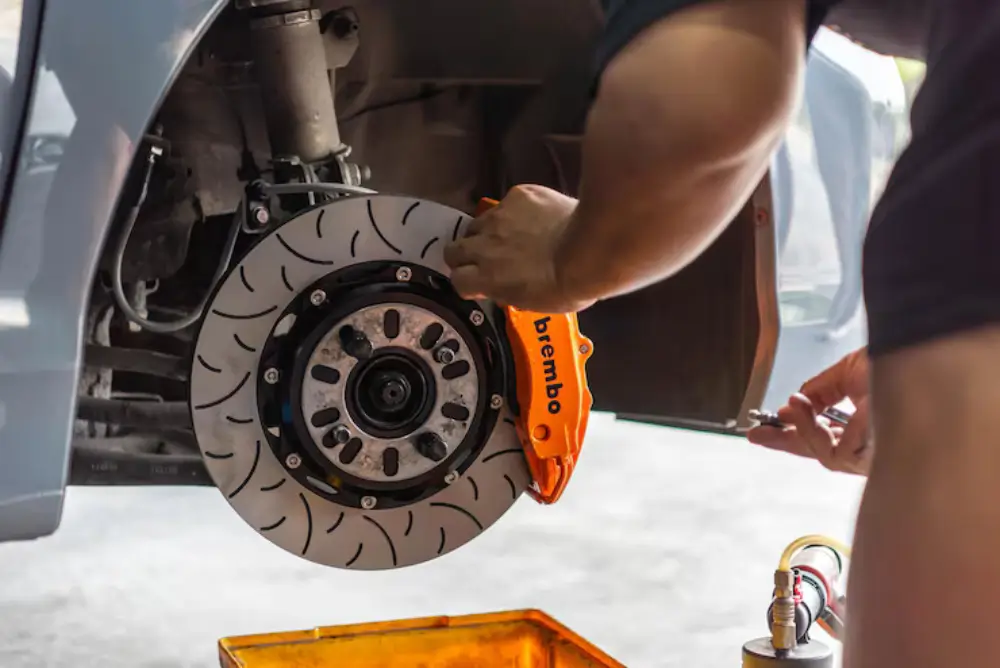
Signs your brakes need work
- Squealing when braking: Brake pad wear indicators are designed to squeal when pads reach minimum thickness. This is a warning — replace before the warning becomes a grinding noise.
- Grinding when braking. Metal-on-metal contact: Pads have worn through to the backing plate and are now gouging the rotor. Immediate workshop visit required. Continuing to drive destroys the rotor and potentially the caliper.
- Pedal goes soft or spongy: Air in the brake lines, a fluid leak, or a failing master cylinder. Safety critical — book in immediately.
- Pedal sinks to the floor slowly Master cylinder failing internally. Brakes will stop working completely at some point.
- Pulling to one side when braking: One caliper not releasing properly, or a fluid restriction on one side. Uneven braking force is dangerous at highway speed.
- Vibration through the pedal under braking: Warped rotors, usually from overheating (hard sustained braking downhill, or sticky caliper keeping the pad on the rotor). Machine or replace the rotors.
- Burning smell after highway driving: Caliper sticking — pad is not releasing properly from the rotor, generating heat. Fix before the caliper seizes entirely.
- ABS warning light on the dash: ABS sensor, module, or wiring fault. Car still brakes, but ABS (anti-lock) is disabled — longer stopping distance on wet roads and emergency stops.
Brake pad materials — what we use
- Ceramic pads: Low dust, long life, excellent performance in normal driving. Our default for most cars.
- Semi-metallic: Better high-temperature performance, more dust, slightly shorter rotor life. Used on performance vehicles and heavy 4WDs.
- Organic: Old-school material, cheap, dusty, shorter life. We don’t fit these.
- OEM pads: For European cars where the car’s brake sensors need matched pads, or customers who want genuine. More expensive, sometimes required.
How long brake pads last
Highly variable. Typical ranges:
- City driving, Brisbane traffic: 30,000 to 60,000 km front, 60,000 to 100,000 km rear.
- Highway driving mostly: 60,000 to 100,000 km front, 100,000+ km rear.
- Heavy 4WD or towing: 30,000 to 50,000 km all round, more wear front.
- Taxi, rideshare, delivery: 20,000 to 40,000 km — these cars wear brakes fast.
Front brakes wear faster than rear because they do 70 percent of the stopping work. That’s why most of our customers only ever replace fronts and front rotors.
The brake inspection process
- Visual: Pads, rotors, calipers, hoses, fluid level and condition.
- Measurements: Pad thickness (new pads are 10 to 12 mm, minimum is 3 mm). Rotor thickness against minimum spec.
- Function check: Pedal feel, handbrake travel, pedal hold (pedal should stay firm under constant pressure).
- Road test if needed: Pulling, vibration, noise all tested under light and hard braking.
- Quote: What needs doing now, what can wait, what to monitor.
Why we prefer quality aftermarket pads
Genuine pads from a dealer typically cost 2 to 3 times what a quality aftermarket pad costs — and in many cases, the “genuine” pad is literally the same part from the same supplier, just in different packaging. Bendix, Ferodo, TRW and Akebono supply pads to most car manufacturers. We fit those brands for less than dealer pricing.
For European cars where the brake sensors have to match the pad, we can fit either genuine or branded equivalents that include compatible sensors. You choose — we give you honest pricing on both.
Brake fluid — why it matters
Brake fluid is hygroscopic: it absorbs moisture from the atmosphere through the master cylinder cap, the caliper seals, and the rubber brake hoses. Moisture lowers the boiling point of the fluid. Under heavy braking (long descent, towing, repeated hard stops), hot fluid with moisture boils. Steam in the brake lines compresses — your pedal sinks to the floor with no braking effect.
Fresh brake fluid has a boiling point of around 230°C. Three-year-old fluid can boil at 150°C. That difference can be the difference between stopping and not stopping on a bad day.
We flush brake fluid every 2 years. $149. Cheapest safety insurance on a car.
What we look at that others miss
- Brake hose condition: Rubber brake hoses perish from heat and age. Swollen, cracked, or leaking hoses are a fail. We replace at the first sign of degradation, not when they’ve already failed.
- Caliper slide pins: These need grease to slide freely. Seized slide pins cause uneven pad wear and vibration. We clean and re-grease every brake service — not every workshop does this.
- Backing plate for the pads: Some cheap pads have thin backing plates that flex under load. We feel for this during installation.
- Wheel speed sensors (ABS): Cracked or loose sensors cause intermittent ABS warnings. Quick check during every brake job.
Areas we serve
Jindalee, Mount Ommaney, Middle Park, Sinnamon Park, Jamboree Heights, Westlake, Riverhills, Sumner, Seventeen Mile Rocks, Forest Lake, Oxley, Corinda, Sherwood, Graceville, Indooroopilly, Taringa, Kenmore, Chapel Hill, Fig Tree Pocket, Brookfield, Bellbowrie, Moggill, Toowong and all inner-west suburbs.
Frequently Asked Questions
How urgent is a grinding brake noise?
Urgent. Metal-on-metal means pads are gone, rotor is getting damaged, and stopping distance is already compromised. Book in this week.
Do I need to replace rotors every time I replace pads?
No. Rotors can be reused if they are within spec thickness and not scored or warped. We measure and advise. Most cars get two sets of pads per set of rotors.
How long does a brake pad replacement take?
Front or rear only: 1.5 to 2 hours. Front and rear together: 3 hours.
Can I drive home after a brake failure warning?
If the pedal is firm and the car stops, you can drive directly to a workshop. If the pedal is soft or sinking, do not drive — get the car towed.
Do you do performance brake upgrades?
Yes. Slotted rotors, performance pads, stainless braided hoses. Common on 4WDs used for towing and on performance cars. Quoted on request.