
Clutch Repair in Brisbane — Jindalee Workshop
A manual transmission clutch is the most expensive wear item on a manual car, and one of the most commonly misdiagnosed. Some symptoms look like a clutch failing when they’re actually hydraulics. Some symptoms look like hydraulics when they’re actually a pressure plate problem. Ultimate Car Expert does clutch diagnosis and replacement at our Jindalee workshop, with the senior technician who has rebuilt hundreds of them.
Clutch replacement pricing
- Standard clutch replacement (most passenger cars, small SUVs): From $1,249 fitted. Includes clutch kit (pressure plate, friction disc, release bearing), spigot bush if applicable, flywheel machine if needed, fluid top-up, road test.
- Mid-size clutch (larger sedans, mid-size SUVs): From $1,449 fitted.
- 4WD / dual-cab ute clutch (Hilux, Ranger, Navara): From $1,649 fitted. Heavier-duty clutches, more labour to drop the gearbox.
- European / prestige clutch (BMW, Audi, Mercedes): From $1,849 fitted. OEM parts required, more complex removal.
- Dual-mass flywheel replacement (if required): Add $450 to $950. Common on diesel utes, European cars, and some modern performance cars.
- Clutch hydraulics (master or slave cylinder, concentric slave): $289 to $689 depending on component and vehicle.
- Clutch fluid flush: $119. Recommended every 3 years.
Prices are a guide. Final pricing depends on your vehicle and the work required, and we’ll confirm your quote before we start.
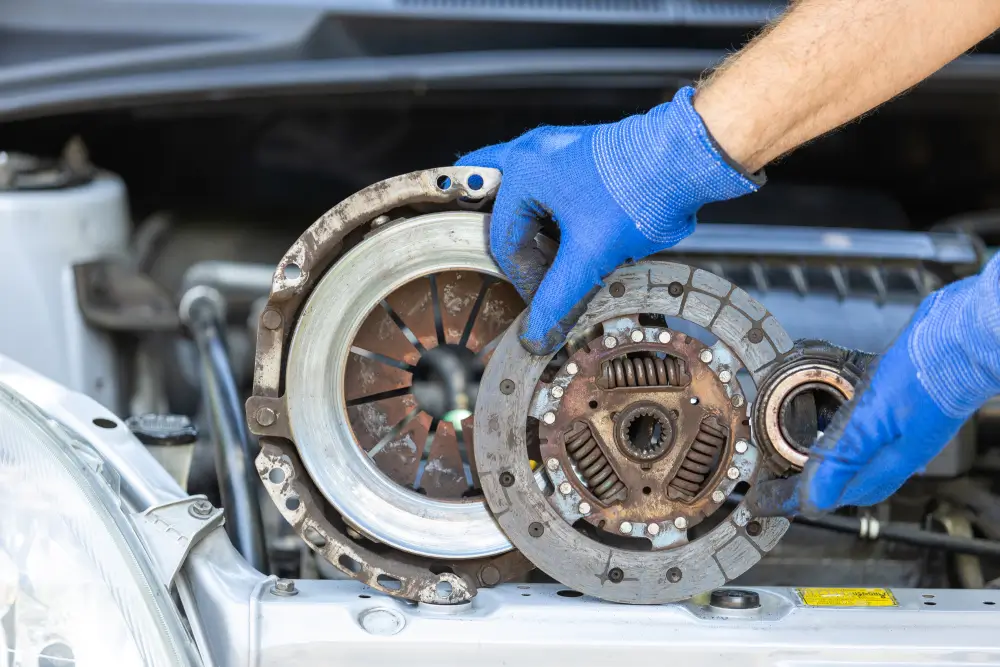
Signs your clutch needs replacement
- Slipping: Engine revs climb on acceleration but the car doesn’t accelerate in proportion. Most noticeable in higher gears on hills — you’re in third gear at 80 km/h, apply throttle, engine revs go up but speed doesn’t. The friction material on the clutch disc is worn to the point where it can’t transmit full torque.
- Clutch judder or shudder: Rough engagement from a standstill. The car lurches or vibrates as you release the pedal instead of engaging smoothly. Usually a worn or contaminated friction disc, or a warped pressure plate. Sometimes a dual-mass flywheel failing.
- Clutch pedal feels spongy or inconsistent: Hydraulic problem. Air in the system, failing master or slave cylinder, fluid leak. Not a clutch replacement — just hydraulics.
- Clutch pedal sticks to the floor: Master cylinder failing. Sometimes slave cylinder. Immediate repair needed — you cannot change gears reliably.
- Noise that changes when clutch pedal is pressed: Release bearing failing. The bearing sits on the transmission input shaft and engages when you push the pedal. A growling or whining noise that changes with pedal position = bearing on its way out.
- Difficulty engaging reverse or first gear: Sometimes clutch, sometimes gearbox synchros. Proper diagnosis needed.
- Burning smell after hills or heavy traffic: Clutch slipping and overheating. Cook it for long enough and you destroy it entirely.
- Clutch pedal bite point very high (close to top of pedal travel): Clutch disc is nearly worn out. Replacement within weeks to months, depending on driving.
How long a clutch lasts
Hugely variable. Depends on:
- Driving style: Riding the clutch in traffic, slipping it from standstill, launching hard — all shorten life. Smooth shifts with full pedal travel and no slipping extend life dramatically.
- Traffic conditions: Brisbane stop-start traffic is harder on a clutch than highway driving. A clutch that lasts 200,000 km on a rural driver might last 80,000 km on an inner-city commuter.
- Vehicle type: Commercial utes carrying loads wear clutches fast. Hot hatches driven enthusiastically wear fast. Diesel utes with dual-mass flywheels have their own failure patterns.
- Typical ranges: 100,000 to 250,000 km for a well-driven car. 60,000 to 120,000 km for heavy use or poor driving.
What gets replaced in a clutch job
A proper clutch replacement isn’t just swapping the friction disc. The kit includes:
- Friction disc: The actual wear item — the disc that engages against the flywheel.
- Pressure plate: The spring-loaded plate that clamps the friction disc to the flywheel. Has its own wear pattern and fatigue life.
- Release bearing (throw-out bearing): The bearing that engages the pressure plate when you press the pedal. Always replaced with the clutch because labour to replace it separately is the same as doing the whole clutch.
- Spigot / pilot bush or bearing: Small bearing at the end of the crankshaft that centres the transmission input shaft. Usually replaced.
- Flywheel: Usually machined flat if scoring is minor. Replaced if cracked, heavily scored, or if it’s a dual-mass flywheel that has failed.
- Hydraulic fluid: Topped up or bled after the job.
- Gear oil (if the box has been drained for removal): Refilled to spec.
All of this is included in the fitted price.
The dual-mass flywheel question
Dual-mass flywheels (DMF) are common on diesel utes (Hilux, Ranger, D-Max, Triton), European cars, and some modern performance vehicles. They reduce drivetrain vibration but they wear out.
A failing DMF makes rattling or clunking noises at idle with clutch disengaged. It causes clutch judder. It can destroy a new clutch within 10,000 km if you replace the clutch without replacing a failed DMF.
Replacing the DMF doubles the parts cost on most cars: Adding $450 to $950 to a clutch job feels painful. But doing a clutch without checking the DMF, and the DMF failing six months later, means doing the entire job again.
Our diagnosis includes inspecting the DMF for play, rattle, and heat damage. We tell you honestly whether it needs replacing or whether it’s good for another clutch cycle.
Clutch hydraulics — when that's the problem instead
A lot of “my clutch is failing” complaints are actually hydraulic failures. The clutch is fine; the hydraulic system that operates it is not.
Master cylinder. Mounted at the pedal end. Leaks internally (pedal sinks, no clutch operation) or externally (fluid visible in the footwell).
Slave cylinder. Mounted at the transmission end. External type is visible near the bellhousing. Internal (concentric) type sits inside the bellhousing — replacing this requires dropping the transmission, same labour as a clutch job, which is why we often do both together on older cars.
Flexible hydraulic line. Old rubber lines swell internally with age, restricting flow. Causes sluggish pedal response.
Full hydraulic diagnosis before we recommend a clutch replacement. If it’s just hydraulics, the repair is 20 percent of a full clutch job.
Areas we serve
Jindalee, Mount Ommaney, Middle Park, Sinnamon Park, Jamboree Heights, Westlake, Forest Lake, Oxley, Corinda, Sherwood, Indooroopilly, Taringa, Kenmore, Chapel Hill, Fig Tree Pocket, Brookfield, Bellbowrie, Moggill, Toowong and surrounding suburbs.
Frequently Asked Questions
How long does a clutch replacement take?
Most jobs are done in a single day, around 6 to 8 hours. Some front-wheel-drive cars and some 4WDs are longer. Drop off morning, collect end of day.
Can I drive the car with a slipping clutch?
Short trips yes, long highway drives no. The more you slip it, the more you overheat the clutch and the faster it fails completely. Book in promptly.
Is it worth fitting a heavy-duty clutch?
Only if you’re towing heavy, lifting the vehicle for off-road use, or modifying the engine. HD clutches are heavier at the pedal and abrupt in engagement on a standard car.
Can I buy a cheap clutch kit online and get you to fit it?
We prefer not. Cheap clutch kits often fail within 12 months. We use Exedy, Sachs, LUK, or OEM — brands we can warranty. If you supply parts, we cannot warranty the job.
Does clutch fluid need changing?
Yes, every 3 years. Brake and clutch fluid are usually the same fluid and absorb moisture the same way. Ignored hydraulic fluid is a common cause of cylinder failure.