
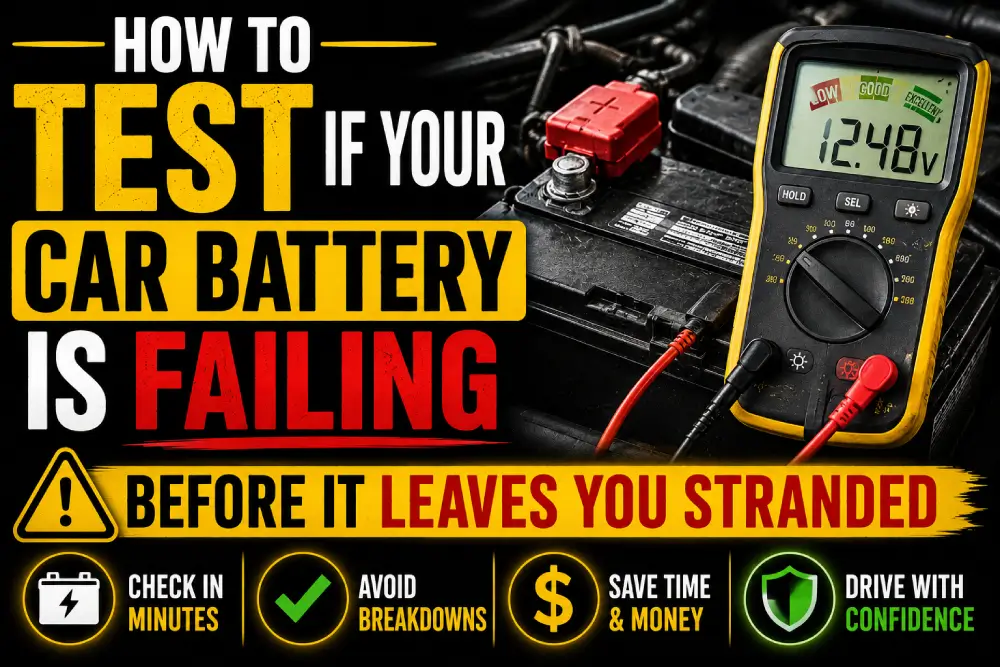
A car battery does not usually fail with warning. It fails in the carpark of a shopping centre at 5 pm on a Friday, or on the morning of a long drive, or in the middle of a heat wave. The roadside callout that follows costs more than the replacement battery itself, and the inconvenience can range from annoying to genuinely consequential.
The reason batteries seem to fail without warning is that most people don’t know what warnings to look for. The signs are there for weeks before total failure. Here is how to read them.
What “failing” actually means
A car battery has two performance characteristics that matter, and they fail in different ways.
Capacity is how much energy the battery can store. Capacity fades gradually as the battery ages, plates corrode, and water evaporates from the electrolyte. A battery with reduced capacity still starts the car normally — it just doesn’t have as much energy in reserve.
Cold cranking amps (CCA) is how much current the battery can deliver in a short burst. CCA is what actually starts your car. A battery that has lost CCA delivers a slow, weak crank, even if its voltage reads normal at rest.
Different tests measure different things. You need both.
Test 1: Visual inspection
Before any electrical testing, look at the battery itself.
Check the case for swelling or bulging. A swollen battery has had internal heat damage and is potentially dangerous. Replace immediately, do not test.
Check the terminals for white or blue-green corrosion. Corrosion adds resistance and starves the starter of current. Even a healthy battery can perform poorly with corroded terminals. Clean with a wire brush and re-grease.
Check the date code. Most batteries have a manufacturing date stamped or stickered on the case. Format varies — sometimes a month/year, sometimes a coded format (A=January, B=February, etc., paired with the year digit). If the battery is over four years old in Brisbane, age alone is reason to test it thoroughly.
Listen for hissing or smell for sulphur. A hissing battery is venting internally because of overcharging or extreme heat damage. Replace.
Check the cell condition (on serviceable batteries only). If the battery has removable caps for each cell, the electrolyte level should be just above the plates. Low levels indicate evaporation from heat. Top up with distilled water if applicable.
Sealed batteries (most modern ones) don’t have removable caps; this test doesn’t apply.
Test 2: Resting voltage with a multimeter
The simplest electrical test. You need a multimeter (under $20 from any auto parts store) and a car that hasn’t been started for at least an hour.
Set the multimeter to DC voltage on the 20-volt scale. Touch the red probe to the positive terminal and the black probe to the negative terminal.
12.6 to 12.8 volts. Fully charged, healthy battery.
12.4 to 12.6 volts. About 75 percent charged. Probably fine but consider charging.
12.2 to 12.4 volts. 50 percent charged. Either the battery has a parasitic drain, or the alternator isn’t charging it properly, or the battery is degrading.
Below 12.2 volts. Significantly discharged. Either deep discharge damage or end-of-life territory.
Below 12.0 volts. Battery is dead or close to it.
This test alone is not conclusive. A battery can read 12.6 volts at rest and still fail to crank the engine. The voltage test screens for major problems but doesn’t measure cranking capability.
Test 3: Cranking voltage
This is the one most people don’t do, and it’s the most diagnostic.
With the multimeter still connected to the battery terminals, have someone start the engine while you watch the voltage. The voltage will drop instantaneously as the starter motor draws current.
Drop to 10.5 to 11.5 volts during cranking. Healthy battery. Engine starts normally.
Drop to 9.5 to 10.5 volts. Battery is weakening. Still starts the car but reserve is fading.
Drop below 9.5 volts. Failing battery. Cold mornings will start causing problems. Replace.
Drop below 8 volts. Effectively failed. Replace immediately.
This test reveals batteries that read fine at rest but cannot deliver the cranking amps needed. Many “good voltage but car won’t start cold” failures show up here.
Test 4: Charging voltage
After the engine starts, leave the multimeter connected to the battery and rev the engine to about 2,000 rpm.
13.8 to 14.7 volts. Healthy alternator output, charging the battery correctly.
Below 13.5 volts. Undercharging. The battery is being slowly depleted while you drive.
Above 14.8 volts. Overcharging. Boils the electrolyte and shortens battery life.
This test reveals charging system problems that cause batteries to fail prematurely. If you’ve gone through two batteries in three years and never tested the alternator, this test might explain why.
Test 5: Load testing
The professional version of cranking-voltage testing. A load tester applies a calibrated electrical load to the battery (usually half the CCA rating for 15 seconds) while measuring how the voltage holds up under that load.
A healthy battery holds above 9.6 volts throughout the 15-second test. A failing battery drops below 9.6 volts before the test completes.
Most workshops offer free load testing as part of any service. If you’re suspicious about your battery and don’t own a load tester yourself, asking for the test at the next oil change costs nothing and produces a definitive answer.
The observational tests
You don’t need instruments to detect a failing battery. Watch for these symptoms:
Slow crank in the morning. The first start of the day is the hardest. A battery that turns the engine slowly on the first start but normally on subsequent starts is showing weakness that will progress.
Slow crank when the engine is hot. Counterintuitive, but heat increases the internal resistance of a degraded battery. If your car cranks slower on a 35-degree afternoon than on a cool morning, the battery is approaching end of life.
Headlights dim when idling. Especially noticeable with the AC on. The battery cannot support the electrical load without the alternator working harder than it should.
Battery warning light flickering. Even an occasional flicker means the charging voltage is dropping below normal somewhere in the system. Investigate immediately.
Dashboard electronics resetting after starts. Clock losing time, radio resetting, infotainment slow to load. Indicates voltage drop low enough to glitch the electronics, which means cranking voltage is sub-par.
Auto-stop-start not working. Cars with stop-start systems disable the function when the battery is too weak to handle the cycling. If your stop-start has stopped working and you don’t remember disabling it, the battery is the likely cause.
What to do with the results
The tests above produce a clear picture. A battery that passes all five tests is healthy. A battery that fails the cranking voltage test or the load test needs replacement, even if other tests pass. A battery that fails the resting voltage test combined with any symptom should be replaced.
The mistake people make is testing once and concluding all is fine. Battery degradation is gradual. The test you ran six months ago doesn’t tell you about the battery today.
For batteries between three and five years old in Brisbane: test every six months. Before any long road trip. Before the heat of summer arrives.
When pre-emptive replacement makes sense
A battery that is four-plus years old and still passes tests is borderline. Replacement now buys reliability for the next three or four years. Waiting until it fails means the inconvenience and cost of failure on top of the replacement.
The simplest rule: if the inconvenience of being stranded once would be worse than the cost of an early replacement, replace pre-emptively at four years. Most drivers fall into that category.
Frequently asked questions
Can I test my own battery without buying tools?
The visual and observational tests need no tools. Voltage tests need a $20 multimeter. Load testing needs equipment most workshops provide free.
My voltage reads 12.6 but the car won’t start. What’s wrong?
The CCA has dropped to a level too low for cranking even though resting voltage is normal. The cranking voltage test would reveal this — and replacement is needed.
How long should a car battery last?
In Brisbane, three to five years for standard lead-acid; four to six years for EFB; five to seven for AGM. Hot climates shorten these ranges.
Can a battery suddenly fail without warning?
Genuinely sudden failures happen but are rare. Most “sudden” failures had warning signs the owner didn’t recognise.
Should I disconnect the battery if I’m not driving the car for a few weeks?
Yes, for storage of a month or more. Or use a maintenance charger. Modern cars draw small currents continuously through alarms and modules, and a few weeks of that drain can flatten a healthy battery.