
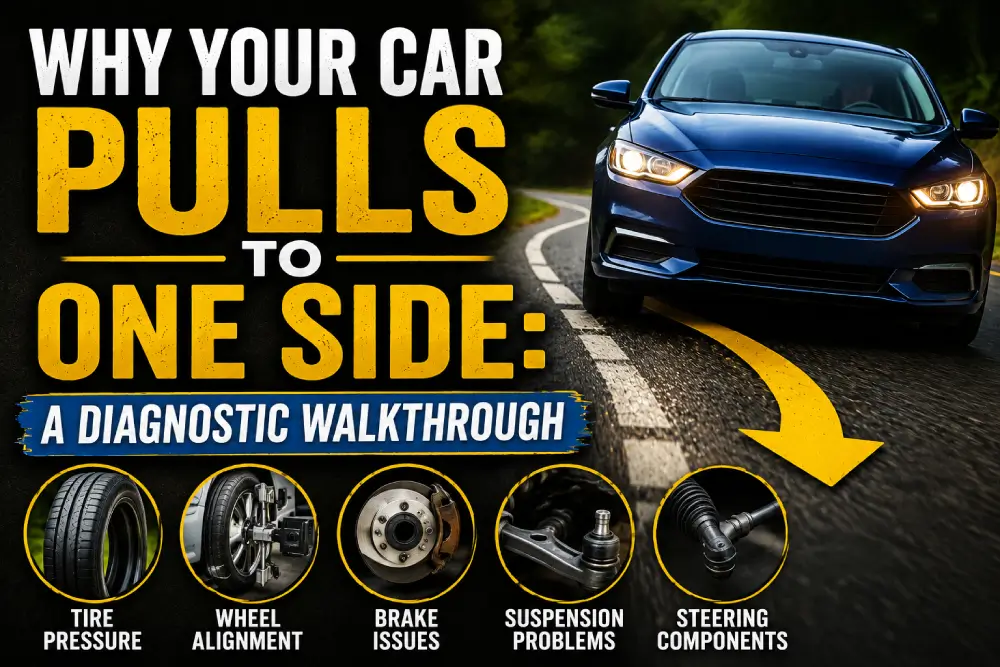
A car that pulls to one side on a level, straight road is not just annoying. It is the symptom of one of six or seven specific underlying problems, and which one you have determines whether the fix costs $30, $250, or a thousand. The good news is you can diagnose most of them yourself in 20 minutes before paying anyone to look.
Here’s the systematic approach a workshop uses, in the order it should be done.
Step 1: Confirm the pull is real
Find a road you know is flat. Most roads have slight cambers built in to drain water — that natural slope causes any car to drift slightly toward the kerb. The test you want is a multi-lane road in light traffic, where you can briefly let go of the wheel on a section you’ve verified is level.
If the car genuinely pulls, it will track measurably toward one side within a few seconds. If it drifts gradually and only with road camber, you don’t have a pull — you have a normal car.
Try both directions on the same road. If the car always pulls toward the same compass direction, road camber is the cause. If it always pulls toward the same side of the car (e.g., always toward the driver’s side regardless of direction), you have a real problem to chase.
Step 2: Check tyre pressures first
This is the cheapest possible diagnostic step and it solves around 30 percent of pull complaints.
Tyre pressures change unevenly. The pressure your tyre had a month ago is not the pressure it has today. A 5 PSI difference left to right is enough to cause a pull, and it doesn’t even need to be obvious by looking.
Set all four to the manufacturer’s specification, listed on the placard inside the driver’s door jamb (not the maximum number on the tyre sidewall). Check on cold tyres before driving. Drive 5 minutes and see if the pull is gone.
This one step has saved many drivers a workshop visit.
Step 3: Swap tyres front-to-rear on the same side
If pressures are correct and the pull persists, the next test isolates the front tyres. A tyre with internal belt damage or conicity (a manufacturing defect causing a slight cone-shape to the tread) pulls the car in the direction of the high side of the cone.
Swap the front-left tyre with the rear-left tyre. Drive again.
- If the pull stays the same direction, the front tyres are not the cause.
- If the pull reverses or disappears, you have a defective front tyre. Replace it.
- If the pull moves to the other side, same conclusion.
Do this before paying for an alignment, because alignment cannot correct a defective tyre.
Step 4: Look at the tyre wear pattern
Get the car parked, run your hand across each tyre’s tread from inside to outside.
Inside edge worn smooth, outside edge full. Excessive negative camber on that wheel. Suspension or alignment.
Outside edge worn, inside edge full. Positive camber or excessive toe-out.
Feathered wear — sharp on one side of each tread block, smooth on the other. Toe alignment is significantly out.
One tyre with notably more wear than the others. That corner of the car has alignment or suspension issues.
If you see uneven wear, you have a confirmed alignment or suspension problem. The pull is the symptom; the wear is the proof.
Step 5: Brake check
If the pull only happens when you apply the brakes (the car was tracking straight, you brake, it pulls), you have a brake problem, not an alignment problem.
The likely causes:
Sticking brake caliper. The piston isn’t releasing fully. One side keeps light braking pressure on the rotor. Symptoms include the pulling-on-braking, a warm wheel after a short drive, and sometimes a burning smell. Caliper service or replacement is the fix.
Contaminated brake pad. Oil or grease from a leak has reached the friction surface of the pad. The contaminated pad has lower friction and the other side bites harder. Replace pads on the affected axle.
Failing brake hose. Internal degradation of a rubber brake hose restricts fluid flow to one caliper. Less common but happens on older cars. Inspect for swelling or cracking.
If the pull is only under braking, alignment is not the answer.
Step 6: Visual suspension inspection
If you’ve passed the tyre and brake tests, the issue is likely suspension geometry. Park on level ground and look at the car from a few metres back.
- Does one corner sit visibly lower than the others?
- Does the gap between the tyre and the wheel arch differ left to right?
- Is one wheel obviously cambered differently from its pair?
A failed spring on one corner drops that side and changes the geometry of every angle. A bent control arm or strut after a kerb impact does the same. Look for visible asymmetry.
If you see anything obvious, that’s almost certainly your cause. Even small visible differences are usually significant.
Step 7: Alignment check
If everything above checks out, the issue is most likely alignment that has drifted out of spec without an obvious cause — typically through gradual bushing wear, repeated pothole hits, or a single hard kerb encounter you’ve forgotten about.
A proper four-wheel alignment costs $129 to $149 and takes under an hour. The technician measures the current angles, compares against the manufacturer’s specification, and corrects whatever is adjustable. You get a printed report showing before and after.
If alignment is the cause, it gets fixed at this step. If it isn’t, the alignment report will show the angles were already correct and you need to dig deeper.
Step 8: The deeper causes
When alignment is correct, tyres are good, brakes are healthy, and the car still pulls, the remaining suspects are:
Worn upper or lower control arm bushes. The arm can flex under load, allowing alignment to shift dynamically when the car is moving even though static measurements are correct. Diagnosable by pushing/pulling on the arm with a pry bar to feel for excessive movement.
Worn strut top mount. The strut isn’t rotating freely through its bearing, causing the steering geometry to bind asymmetrically.
Failing wheel bearing. Late-stage bearing failure can cause directional pull as the hub loads up unevenly.
Power steering rack imbalance. Hydraulic systems can develop pressure imbalances internally. Rare. Diagnosed by elimination.
When the pull is intermittent
A pull that comes and goes points to a hydraulic or thermal issue. Cold brake pads grip differently than warm ones. A sticky caliper that frees up after heat soak. A power steering pump that loses pressure when hot.
Intermittent pulls are harder to diagnose because the workshop can only test what’s happening at the moment. Note the conditions: cold, warm, dry, wet, highway, urban. Bring the data to the diagnosis.
What workshops should not do
A pull complaint that gets answered with “let’s just do an alignment” without the workshop testing tyre pressures, tyre conicity, brake drag, or suspension condition is bad practice. Alignment fixes alignment problems. Spending $130 on an alignment when you actually have a defective tyre means you’ll be paying again next week.
A good workshop asks questions, drives the car, inspects with the car in the air, then quotes the actual fix.
Frequently asked questions
My car only pulls at highway speed, not at city speed.
Suggests an aerodynamic effect or tyre conicity that loads up with speed. Less likely to be alignment, which would show at any speed.
The car pulls one way under acceleration and the other under deceleration.
Suspension bush wear, allowing the wheel to shift under load. Common on FWD cars with tired lower control arm bushes.
Will an alignment fix uneven tyre wear?
It will stop the wear from getting worse. The damage already done is permanent. Replacement of the worst-affected tyre is often the right answer alongside alignment.
Can I align the car myself?
Toe can be roughly adjusted with string and a tape measure, but camber and caster need proper measurement equipment. Not realistic for most home mechanics.
Why does my new car pull slightly?
Some new cars come from the factory with alignment near one edge of the tolerance range. A pull-spec alignment (intentionally setting the car slightly to compensate for road camber) is a valid workshop request and usually free under warranty.