
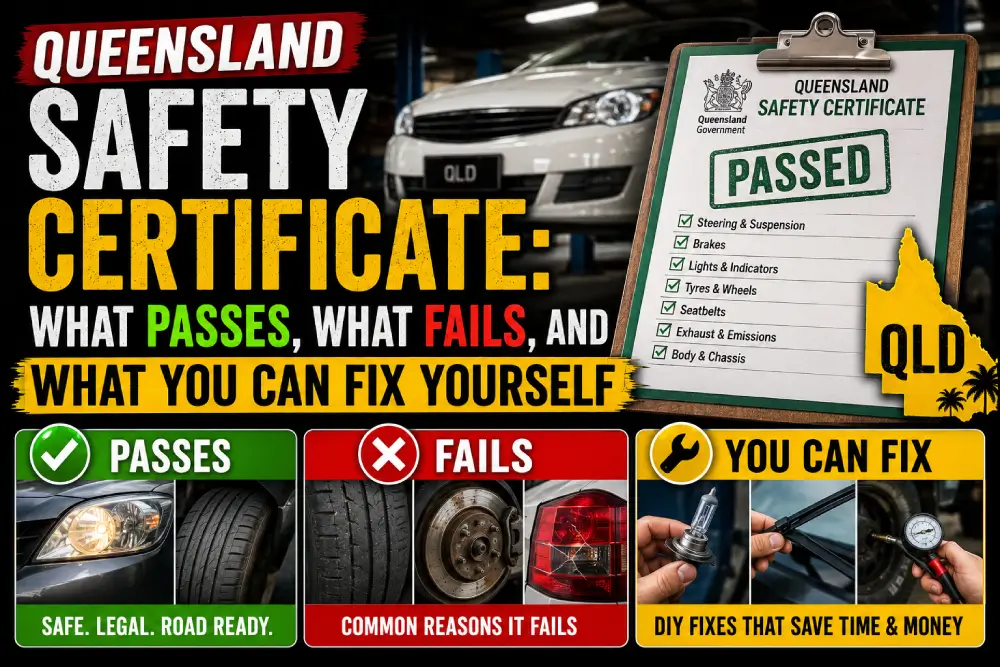
If you’re selling a registered car in Queensland, transferring ownership, or registering a vehicle that came in from interstate, you need a Safety Certificate. The certificate confirms your vehicle meets minimum legal safety standards on inspection. It is not a guarantee that everything works; it is a confirmation that the safety-critical items are within tolerance.
Around one in four certificates result in a fail report on the first inspection. Some of those fails are fixable in a driveway with $10 of parts. Some need a workshop. Knowing the difference saves time and money before you book.
What gets checked
The QLD inspection covers more than 40 individual items grouped into seven categories. The full criteria are published by the Department of Transport and Main Roads, but in practice the items that fail cars are concentrated in a smaller subset.
Tyres. Tread depth above 1.5 mm at any point on each tyre. No sidewall damage. No cord exposed. Wheels properly torqued. No cracked alloys. Spare tyre in serviceable condition if fitted.
Brakes. Pad thickness adequate (no metal-on-metal). Rotors not heavily scored. Handbrake holds the vehicle on a slope. Pedal feel firm. No fluid leaks. Brake hoses not perished or swollen. ABS warning light not illuminated.
Lights. Every globe functional — headlights high and low, brake lights, indicators front and rear, reverse lights, tail lights, number plate lights, hazards. Headlight alignment within spec.
Steering and suspension. No excessive play in the steering. Ball joints, tie rod ends, and CV boots all in good condition. Shock absorbers not leaking. No broken springs. Sway bar end links and bushes intact.
Body and structure. Doors close and latch properly. Seatbelts retract and lock. No rust in structural areas (chassis rails, sills, floor pans, suspension mounts). Windscreen with no cracks in the driver’s sightline.
Exhaust and engine. No exhaust leaks. Exhaust not louder than 90 dB at idle. Engine and transmission not leaking oil onto the road. No coolant leaks.
Other. Horn works. Wipers and washers functional. Reverse alarm if fitted. Mirrors intact and adjustable. Speedometer functional.
That’s the checklist. Most of it is binary — either it works or it doesn’t.
What you can fix yourself before the inspection
A pre-inspection sweep of your own car catches around half of the common fails. None of these need specialised tools.
Walk around with the hazard lights on. Confirm every indicator front and rear is flashing. Replace any failed globe with the correct replacement (the owner’s manual or any auto parts retailer can match).
Press the brake pedal while someone watches the brake lights. All three lights (two main + high mount) need to work. Sometimes one fails and the others compensate enough that you don’t notice during driving.
Walk around with the headlights on, both low and high beam. Confirm both work on both sides. Aim is harder to test yourself, but a clear visual that one beam is significantly higher or lower than the other suggests misalignment.
Open the bonnet and check fluid levels. Engine oil, coolant, brake fluid, power steering, washer fluid. Low fluid by itself isn’t a fail, but visible leaks are.
Check the windscreen for cracks. Any crack in the driver’s sweep area is a fail. Star chips outside the sweep area generally pass. Repair before inspection is much cheaper than replacement after.
Check the wipers. Streaking or skipping is a fail. Replacement blades are $20 to $40 and take five minutes.
Test the horn. Surprisingly common fail. Often a corroded contact or a blown fuse.
Inspect the tyres for tread depth. Wear indicators (raised bars across the tread grooves) should not be flush with the tread surface. If they are, you’re at or below 1.6 mm and will fail.
Confirm both number plates are present, undamaged, and legible. Faded plates are a fail in some inspections.
Test the seatbelts. Each belt should retract smoothly and lock under a sudden pull. Sticky or unretracting belts fail.
Test the handbrake on a slope. It should hold the car with the wheels chocked.
This 20-minute self-inspection eliminates the most common low-effort fails. The inspection then proceeds without surprises.
What needs a workshop before the inspection
Some items can only be assessed properly on a hoist or with specialised equipment.
Brake pad thickness. You can sometimes see pads through alloy wheel spokes, but accurate measurement requires the wheel off.
Suspension component condition. Ball joints, tie rod ends, and bushes need load tests with the wheel free to move.
Exhaust leaks. Some leaks are obvious; some are only audible with the car on a hoist and the underbody accessible.
Underbody rust. Floor pans, chassis rails, and suspension mount points are inaccessible from above.
CV boot integrity. Torn CV boots leak grease and accumulate road grime. Visible only from underneath with the wheel turned.
Wheel bearing play. Requires raising the wheel and rocking it to feel for movement.
If you’re not sure about any of these, a pre-inspection check costs less than a re-inspection. Most workshops offer pre-inspection scans for $50 to $90 that identify what would fail before you commit to the certificate.
Common reasons cars fail
After thousands of inspections, the same items show up over and over.
Worn tyres on the inside edges. Caused by alignment issues, but the tyre is the visible fail. Replacement plus alignment to prevent re-occurrence.
Headlight alignment. Often disturbed by minor front-end work, kerb hits, or even loaded suspension. Fixable on the alignment gear at any workshop in under 30 minutes.
Oil leaks dripping onto the ground. Drips that stay on the engine or splash shields are usually fine. Drips that reach the floor are a fail. Rocker cover gaskets and oil filter housing seals are common culprits.
Worn brake pads or scored rotors. Often discovered for the first time at inspection because the wear indicator wasn’t audible to the driver.
Perished CV boots. Almost universal on cars past 150,000 km if never inspected.
Failed indicator globes. People often don’t notice until the car is in front of the inspector.
Window tint over the legal limit. Front side windows must have at least 35 percent VLT (visible light transmission). Some aftermarket tinting goes darker. Removal and replacement is common.
Cracked windscreens. Brisbane road debris on the highway is the usual cause.
Aftermarket exhausts exceeding the dB limit. Performance enthusiasts particularly. The 90 dB static test catches loud aftermarket systems.
What happens after a fail
A failure report lists the specific defects. You have 14 days to repair and return for a free re-inspection at the same workshop. The same inspector will check only the items that failed.
You can choose to fix the failures elsewhere. The original workshop has no obligation to do the work. Some inspectors will quote the repairs on the spot; you can compare with other workshops before committing.
If you exceed the 14-day window, a fresh full inspection is required. The clock matters.
What the certificate doesn’t tell you
A Safety Certificate is a snapshot of safety-critical items at the moment of inspection. It is not a comprehensive mechanical condition report. The certificate can be issued on a car with:
- A failing transmission that has not yet caused a leak
- An air conditioning system that doesn’t work (AC is not part of the inspection)
- Engine issues that don’t produce visible leaks (failing turbos, worn injectors)
- Bodywork damage that doesn’t affect structural safety
- Electrical issues that don’t affect lights, indicators, or horn
- Tyres with another 5,000 km of life left rather than 50,000 km
For an honest assessment of a vehicle’s overall mechanical condition before buying, a pre-purchase inspection is the right tool. A Safety Certificate is a legal compliance document, not a mechanical review.
How long the certificate lasts
Private sellers: 2 months or 2,000 km from issue, whichever comes first.
Licensed motor dealers: 3 months or 1,000 km.
If the sale drags past those limits, a new inspection is required.
Frequently asked questions
Can I drive my car home if it fails the inspection?
Yes. A failure is not an unregistered notice. You have 14 days to rectify.
Can the workshop that did my inspection also do the repairs?
Yes, but they don’t have to. Get a separate quote if you want a price comparison.
Will an aftermarket lift kit fail the inspection?
Depends. Up to 2-inch lifts with certified components generally pass. Larger lifts require engineering certificates. Lifts that affect headlight alignment, steering geometry, or bumper height can fail even if “legal.”
Does the inspection check my emissions?
Not directly. Visible smoke and emissions warning lights are inspected. Detailed emissions testing is not part of the QLD Safety Certificate.
What if I disagree witha fail item?
You can request a re-inspection from a different inspector, or escalate to Department of Transport and Main Roads if you believe the inspection was incorrect. The vast majority of disputes are resolved by a second opinion at a different workshop.