
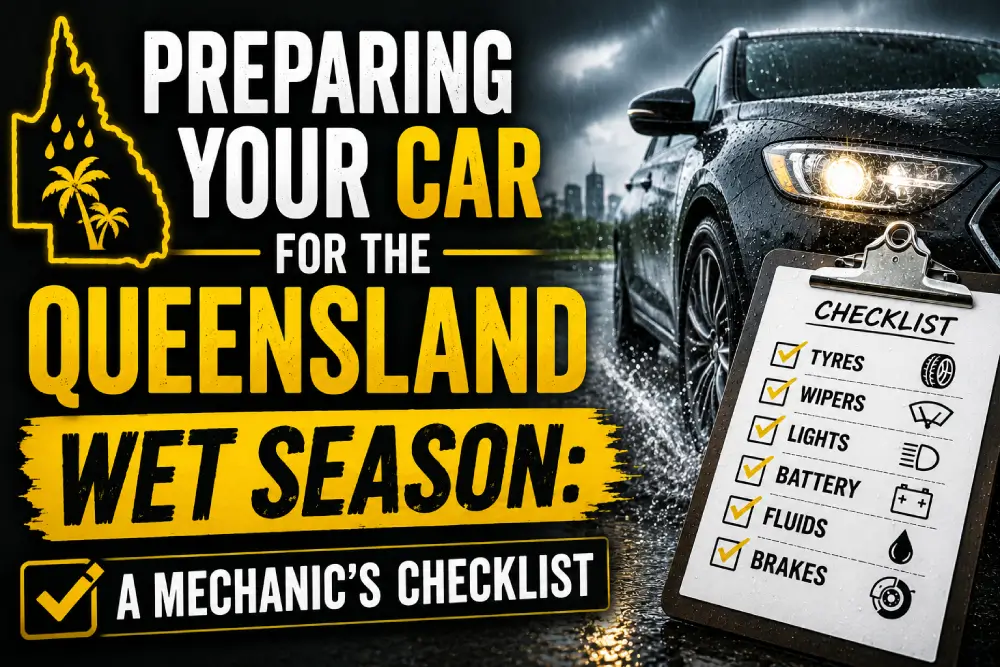
The Queensland wet season runs roughly November through April. For Brisbane drivers that means six months of intermittent storms, flash flooding on the Centenary Highway, sudden 30-millimetre downpours that turn Coronation Drive into a slip-and-slide, and the kind of humidity that finds its way into every car electrical fault waiting to happen.
The cars that come into a workshop with wet-season problems are almost never the cars that were prepared in advance. Here’s what actually matters.
Tyres are the whole game
Stopping distance on wet roads is governed almost entirely by tread depth. The numbers are stark. A passenger car at 80 km/h on a wet road takes around 50 metres to stop on tyres with 7 millimetres of tread. The same car on tyres at 2 millimetres needs 90 metres. The legal minimum in Queensland is 1.5 millimetres, and at that depth the same car needs over 100 metres.
For wet season, the practical recommendation is replacing at 3 millimetres rather than waiting for the legal limit. The difference between “still legal” and “actually safe in a storm” is around 25 metres of stopping distance at urban speeds.
The other tyre question is age. Even tyres with plenty of tread harden as they age, and a tyre over six years old has lost much of its wet grip regardless of how it looks. Find the date code on the sidewall (four digits, e.g. 2421 means week 24 of 2021). If your tyres are pushing six years, wet season is the time to replace them, not next year’s birthday.
While the tyres are being looked at, also have the alignment checked. Uneven wear from misalignment puts patches of low tread on parts of the contact patch, which means parts of the tyre have already failed for wet conditions before the rest catches up.
Wipers are 12-month consumables in Brisbane
UV exposure destroys rubber wiper blades faster in Brisbane than in temperate climates. A set of blades that lasts two years in Melbourne lasts about 12 months here. Streaking, juddering, or skipping across the screen means they need replacing before the first heavy downpour, not during it.
Replace both fronts together. They wear at similar rates and replacing one leaves you with an inconsistent sweep that distracts at the worst possible moment. Rear wiper too if your car has one — they tend to be forgotten and are the only thing keeping the rear screen usable in a tropical downpour.
Refill the washer reservoir with proper screen wash, not water. Brisbane bugs are seasonal and the proteins in their carcasses don’t shift with water alone, especially when smeared by a worn wiper.
Brakes carry more load in the wet
Wet brakes work differently. The first second of brake application in heavy rain is partly wasted clearing water off the rotor and the pad, which is why your car can feel slower to respond after a long drive through standing water. Healthy brakes recover quickly. Worn brakes, contaminated rotors, or perished hoses do not.
A brake inspection before wet season catches three things that get worse fast in the rain:
Worn pads. A pad with 4 millimetres of friction material in dry conditions still stops the car. The same pad in heavy rain stops slower and overheats more easily. Wet season is not when to let pads run to the wear indicator.
Caliper slide pin corrosion. Brisbane humidity rusts the steel pins that allow the caliper to float. Seized pins cause uneven pad wear and shudder under braking. Easy to fix with a clean and re-grease, but only if it’s caught.
Hose perishing. Brake hoses are rubber and they perish from heat and UV. A swollen or cracked hose under wet-season braking loads is a stopping-distance problem and an MOT fail. Visual inspection costs nothing.
Electrics are where most wet-season callouts come from
Water finds every weakness in an automotive electrical system. The four common failure points before they ever reach a workshop:
Battery terminals. Corrosion at the terminals creates resistance, which prevents the alternator from charging properly during long wet drives with headlights and wipers on full. Clean terminals, dielectric grease.
Boot and door seals. Perished rubber lets water into the boot and footwell. Water in the boot rusts the spare wheel well; water in the footwell rusts the floor and ruins carpet. Check by climbing inside on a clear day with a torch and looking for water staining, or pressing on the carpet for damp.
Headlight assemblies. Cracks or perished gaskets let water condense inside the housing. The bulb still works but the beam pattern goes hazy and reflectors corrode. Look for fogging on a humid morning. Replacement housings are not cheap; catching it before it gets bad means a $40 sealant fix instead of a $400 housing.
ABS sensors. Mud and grit accumulate in the wheel arches. The sensors that read wheel speed for ABS and traction control can be fouled. The dashboard warning light appears, and ABS disengages exactly when you need it. A wash and a check at each wheel hub takes 10 minutes.
Underbody drainage
The drainage channels at the base of the windscreen, in the wheel arches, and along the floor pans are designed to shed water. Leaves and bark from Brisbane’s gum trees block them over winter. By the time the first storm hits, water that should flow away pools instead, eventually finding its way through cabin filters and into the ventilation system.
Lift the bonnet, look at the area where the wiper arms sit (usually a recessed tray), and clear out leaf debris. Same with the channels visible when you open the doors. Five minutes. Saves a wet, mouldy cabin in February.
Air conditioning, of all things
A working AC is not just for cold air. The AC compressor runs whenever you select demist, and demist is what clears a fogged windscreen on a humid Brisbane morning when you cannot see through the glass. An AC that has slowly lost gas over winter will demist poorly. Get the AC serviced in October if you have not had it touched in two years. A regas costs less than a windscreen replaced after a low-visibility accident.
The 30-second pre-storm check
When the radar shows a storm approaching:
- Wipers off the screen, sitting in their park position (not lifted away)
- Sunroof closed
- Windows fully up
- Open the boot and look for the umbrella you forgot
- Why Brisbane Summer Kills Car Batteries Faster Than Winter
The wipers-down detail matters. Wipers lifted away from the screen are vulnerable to wind catching the blade and snapping the spring loaded arm. Keeping them seated against the glass is safer.
Frequently asked questions
Should I switch to wet-weather tyres for wet season?
No. Modern all-season tyres handle Brisbane conditions fine when they have adequate tread. Dedicated wet tyres are for track use.
Does driving through standing water damage the car?
Yes, if the water is deep enough to enter the air intake. Even shallow water at speed throws spray onto the alternator and electronics. Slow down through standing water, or avoid it.
Why does my windscreen fog up faster in wet season?
Humidity inside the car is higher because moisture is brought in on clothes, umbrellas, wet shoes. Using AC on demist removes that moisture; using vent only does not.
Are AWD or 4WD cars safer in the wet?
Marginally for acceleration. No difference at all for braking, which is where most wet-weather accidents happen.
How often should I check my tyre pressures in wet season?
Monthly is enough. Rapid temperature swings during storm fronts cause pressure to drift, so an extra check after a major front isn’t a bad habit.