
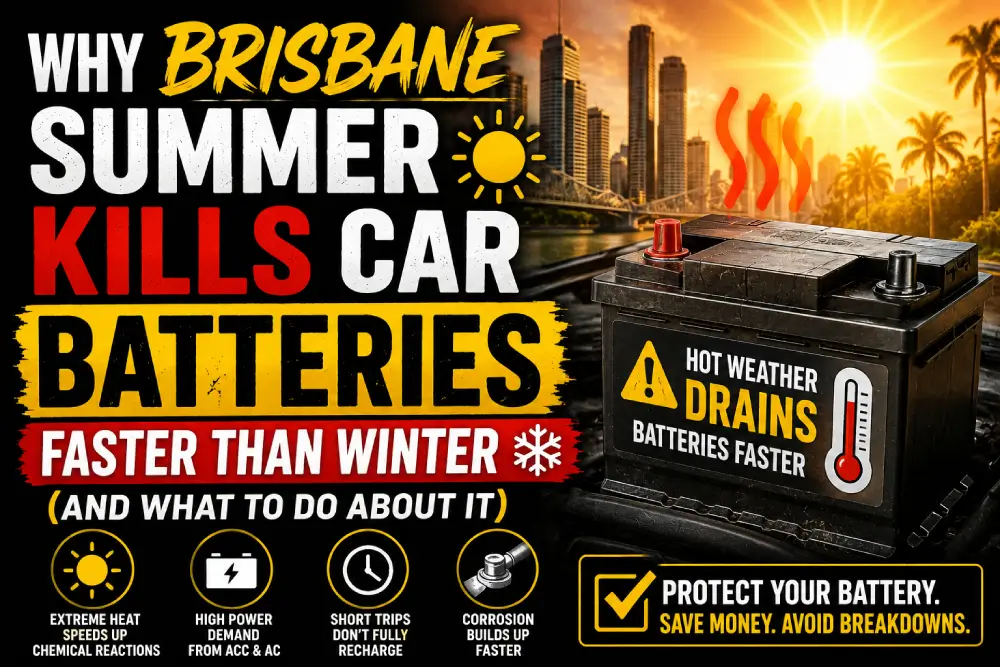
Most drivers grew up hearing that cold mornings kill batteries. That advice came from places where winter mornings sit below freezing. In Brisbane, the opposite is true. Our batteries die in February, not July.
If yours has lasted three years and you’re heading into another Queensland summer, the next four months are when it will probably let you down.
The chemistry, in one paragraph
A car battery is a sealed chemical reaction. Lead plates suspended in sulphuric acid generate current as the electrolyte interacts with the plates. Two things wreck that reaction over time: vibration cracking the internal plates, and heat. In a sealed lead-acid battery (the most common type in Australian cars), heat does two specific kinds of damage. It evaporates water out of the electrolyte through the vent, raising the acid concentration to a level that corrodes the plates. And it accelerates the chemical breakdown of the plates themselves, with corrosion roughly doubling for every 10°C rise in average temperature.
A battery that would last six years in Hobart lasts three to four years in Brisbane. A battery exposed to a black bonnet baking on bitumen in summer can lose 12 months of life in a single hot season.
What actually happens to a battery during Brisbane summer
Daytime ambient temperatures in Brisbane sit between 28°C and 35°C through January and February. The engine bay during normal driving is hotter still, typically 60°C to 80°C, and after the car is parked the heat keeps soaking for another 20 to 40 minutes before it begins to dissipate. A battery sitting in that environment for six straight months goes through tens of thousands of small thermal cycles.
The internal effect is gradual loss of capacity. A battery that started life at 600 cold cranking amps might be at 580 after one summer, 520 after two, 440 after three. The car still starts. The battery still reads 12.6 volts at rest. But the capacity to deliver a strong start is quietly disappearing, and it disappears faster in cars that:
- Park outside in direct sun
- Live in suburbs without garages (most of Brisbane’s western corridor)
- Do short trips only (under 15 minutes), where the alternator never fully recharges the battery between starts
- Run high accessory loads (dashcams, fridge slides, aftermarket audio) that draw current when the engine is off
The summer failure pattern
The classic Brisbane battery failure goes like this. The car has been fine all winter. The first really hot week of November or December hits. One morning the car cranks slowly, but starts. The owner shrugs. Two weeks later, on a 36-degree day, the car will not start at all. Roadside assistance arrives, jump-starts the car, and tells the owner the battery is finished.
This pattern is so predictable that battery manufacturers in Queensland report 60 to 70 percent of warranty replacements happen between November and March. The cold morning that finally finishes the battery is rarely the cause; it is the trigger pulled on damage that already happened during the previous summer.
Early warning signs
A summer-stressed battery does not always announce itself. Watch for:
Slower cranking on hot days, not cold ones. Counterintuitive, but consistent. Heat increases the internal resistance of an already-degraded battery.
Headlights that visibly dim at idle when the air conditioning is on. The AC compressor pulls 4 to 6 amps continuously, and a weak battery cannot support both lights and AC without help from a slightly stressed alternator.
Dashboard electronics glitching on startup. Radio resetting, infotainment slow to boot, sensors throwing one-off warning lights that clear on the next start. The battery is dropping voltage too low during cranking, briefly starving the electronics.
Battery case feels warm long after the engine is off. A healthy battery cools within an hour of shutdown. A failing one stays warm because internal resistance is converting current into heat.
Three years and over. Brisbane batteries simply don’t last as long as their published life ratings, most of which were measured in cooler northern-hemisphere climates.
What actually helps
Park in shade where possible. The difference between a car parked in full sun and a car parked under a carport is around 15°C of underbonnet temperature soak. Over a summer, that buys you measurable battery life.
Drive for at least 20 minutes at a stretch every week. Short trips never give the alternator enough time to recharge the battery fully after the energy spent on starting and running accessories. Two long drives a week are better for battery health than seven short ones.
Get a battery test before December. Any decent workshop will test your battery free as part of a regular service. The test measures cold cranking amps against the battery’s rated spec. If yours has dropped below 75 percent of rated CCA, replacement before summer hits is the right call. A pre-emptive $250 battery is cheaper than a tow plus an emergency callout.
Check the terminals. Corrosion at the terminals adds resistance that mimics a failing battery and creates extra heat. A wipe-down and a smear of dielectric grease takes five minutes and prevents the symptom.
If your car has AGM or EFB (stop-start), do not substitute a cheaper standard battery when it fails. Stop-start cars rely on AGM chemistry for the hundreds of thousands of restart cycles they accumulate. A standard battery in an AGM car will last six to twelve months and damage the alternator on the way out.
When pre-emptive replacement makes sense
If your battery is at three years and showing any of the warning signs above, replace it before November. If it is at four years regardless of symptoms, replace it. Brisbane is not a five-plus year city for standard lead-acid batteries.
The mistake worth avoiding is leaving the decision to the moment of failure. A battery that dies on a cool morning in May costs you the price of a replacement plus a callout. A battery that dies on a 38-degree Saturday in January costs you the same, plus four hours of waiting in the heat, plus rearranged plans for whatever you were trying to do that day.
Frequently asked questions
Will a battery insulator blanket help?
Marginally. They reduce the peak heat soak but don’t address the cumulative effect. They are more useful in deserts than in humid coastal climates like Brisbane.
Can I extend a battery’s life by trickle charging it?
Yes, if the car sits unused for long stretches. A maintenance charger keeps the battery near full state of charge without overcharging. For a daily driver, it isn’t necessary.
Are AGM batteries more heat resistant?
Slightly. The sealed construction reduces water loss, which is the main heat-driven failure mode. AGM in Brisbane typically lasts a year longer than equivalent flooded batteries.
Does the alternator wear out batteries?
A faulty alternator can. Overcharging boils electrolyte; undercharging leaves the battery in a chronic low state. Either accelerates summer failure. Worth testing if you’ve gone through two batteries in three years.
What’s the best time to replace a Brisbane battery?
September or October. Before the heat arrives, after winter prices on inventory have settled. Avoid the December rush when supply tightens and prices firm.