
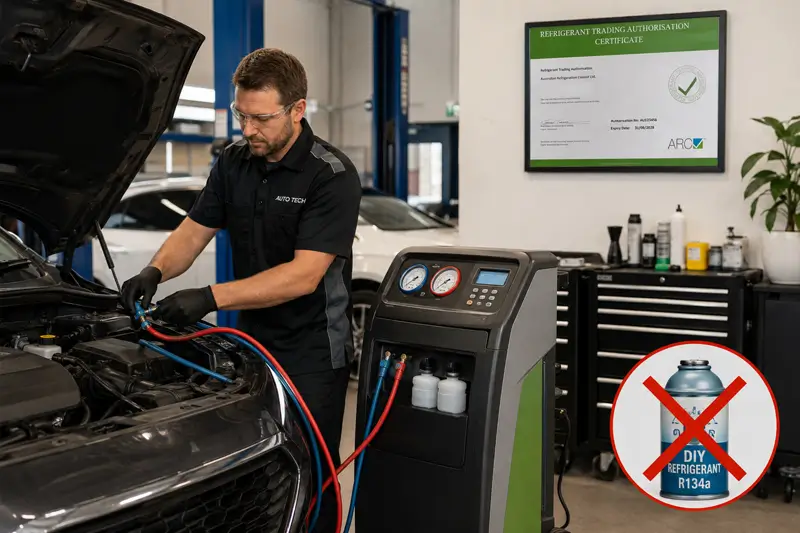
Search “car aircon regas DIY” and most of what comes up is American content: someone in their driveway pushing a $20 can into the low-pressure port. That’s legal to buy over the counter in parts of the US. It isn’t in Australia, and the reason why is worth understanding before you book anyone, whether that’s us or someone else.
What Australian Law Actually Says
R134a and R1234yf, the two refrigerants used in car air conditioning, are both classified as synthetic greenhouse gases under the Ozone Protection and Synthetic Greenhouse Gas Management Act and its regulations. Under that framework:
- An individual needs an ARCtick Refrigerant Handling Licence to handle these gases, meaning to recover, add, or work on a system containing them.
- A business needs a Refrigerant Trading Authorisation (RTA) to legally buy, store and dispose of refrigerant stock.
- Both are administered by the Australian Refrigeration Council (ARC) on behalf of the federal government, and both are checkable.
In practice, this means a member of the public can’t walk into a shop and legally buy a can of R134a to top up their own car parts, the way you can in parts of the US. It has to be handled by, or under, someone holding the appropriate licence.
Why the Law Exists (It’s Not Just Red Tape)
R134a and R1234yf both have a significant global warming potential when released into the atmosphere. Venting old refrigerant instead of recovering it, or topping up a leaking system without fixing it, puts that gas straight into the air. Australia’s regulations exist to stop that happening at scale, which is also why a proper regas always starts with recovering and weighing whatever’s already in the system rather than just adding more on top.
What Can Go Wrong With an Unlicensed Job
Cheap “regas” jobs advertised on local marketplace groups or done in a driveway usually cut one of these corners:
- Some operators vent the old refrigerant into the atmosphere instead of recovering it. This practice is illegal and avoidable.
- Some operators use a cheaper, unapproved hydrocarbon substitute instead of the correct refrigerant. These gases are flammable. Queensland’s safety regulator has specifically warned about illegal hydrocarbon refrigerant installations in vehicle AC systems. A flammable gas near the cabin creates a real fire risk, not a theoretical one.
- Some operators skip the vacuum and leak tests. Without these tests, you cannot know whether the repair actually solved the problem or simply topped up the system again.
None of this is about box-ticking. A workshop that can’t show you a licence or authorisation number is also, by definition, a workshop you have no way of holding accountable if something goes wrong.
How to Check If a Workshop Is Actually Licensed
Ask for their Refrigerant Trading Authorisation number directly. A legitimate workshop will have it on hand, usually displayed on their website footer, invoices, or workshop signage. Ours is AU66890, and it’s on every page of our site.
What a Licence Actually Covers, Beyond Just Adding Gas
Proper licensing covers more than AC regas work. It lets our technicians legally handle refrigerant while they diagnose and replace faulty AC components. This means we can fix the actual problem instead of simply refilling gas around an unresolved fault:
- A/C compressors, condensers and evaporators
- Receiver driers, expansion valves and orifice tubes
- High and low pressure hoses and aluminium refrigerant pipes
- O-rings, seals and pressure switches
- A/C cooling fans and cabin filters
After any of these repairs, the system still goes through the same evacuation, vacuum, leak test and manufacturer-spec recharge as a standard regas. The licence is what makes it legal to recover the refrigerant out of the system before touching any of these parts in the first place.
Frequently Asked Questions
Can I buy a DIY regas can and top up my own car in Australia?
No. Unlike the US, Australia restricts R134a and R1234yf. Only people with an ARCtick licence can legally buy, handle, or work with these refrigerants. This is one of the most common misconceptions we hear, usually from people who’ve seen it done on American YouTube content.
What’s the difference between a Refrigerant Handling Licence and a Refrigerant Trading Authorisation?
A Refrigerant Handling Licence allows an individual technician to physically work on a system containing refrigerant. A Refrigerant Trading Authorisation allows a business to legally buy, store, and dispose of refrigerant stock. A properly set up workshop has both covered.
Is it actually illegal for a workshop to just vent old gas instead of recovering it?
Yes, venting refrigerant to the atmosphere instead of recovering it is a breach of the Ozone Protection and Synthetic Greenhouse Gas Management Regulations. It’s also simply wasteful, since that’s the same gas you’re paying to have replaced.
How do I check if a workshop is properly licensed before I book?
Ask for their Refrigerant Trading Authorisation number. It should be displayed on their website or available on request. If a workshop can’t produce one, that’s worth treating as a red flag rather than a technicality.
Does proper licensing affect the price compared to a cheap driveway regas?
Yes, and honestly it should. Licensed recovery equipment, correct gas storage, and legally compliant disposal all cost real money to maintain, which is part of why a $99 driveway offer is usually cutting a corner somewhere on this list.
Book With a Workshop That Can Show You the Licence
If you’d rather have your car‘s air conditioning handled by a workshop that can actually show you their authorisation, book online or call (07) 3279 3228. Our Refrigerant Trading Authorisation number is AU66890. For current pricing and the full repair process, see our car AC repair and regas page.
Ultimate Car Expert Jindalee, 4/4 Curragundi Rd, Jindalee QLD 4074. ARC Licence AU66890.