
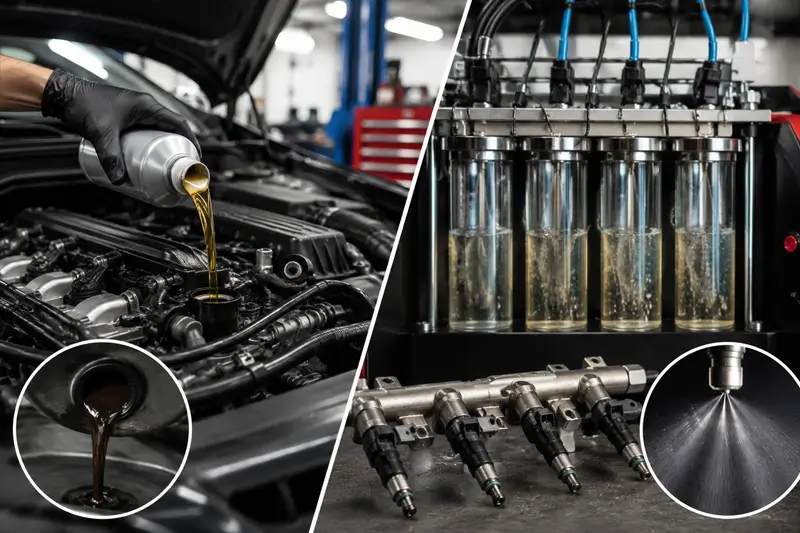
“Do you want the engine flush with that?” is one of those service-desk questions that makes people suspicious, and fairly enough. Plenty of workshops offer it as a blanket upsell on every booking regardless of whether the car needs it. Here’s what an engine flush and a fuel system clean actually do, chemically, who they genuinely help, and the specific case where we won’t recommend one even if you ask for it.
What an Engine Oil Flush Actually Does
Over tens of thousands of kilometres, especially with irregular oil changes or short trips that never let the engine reach full operating temperature, deposits build up inside an engine: sticky varnish on piston rings, sludge in oil galleries, gum around valve train components. None of that shows up on a dipstick check.
The treatment we use, BG EPR (Engine Performance Restoration), is added to the old oil before it’s drained. It’s run at operating temperature for a set period, which softens and dissolves those deposits so they leave with the old oil at drain time rather than staying behind. Done properly, it can free up piston rings that have started sticking and clear passages that feed components like turbochargers and hydraulic valve actuators.
Where it genuinely helps: cars with a patchy service history, higher-mileage engines that have had long gaps between oil changes at some point, and GDI (direct injection) engines, which are more prone to internal deposit buildup than older port-injected designs.
Where We Won’t Recommend It
This is the part most service menus leave out. BG’s own product documentation for EPR is explicit: it should not be used on an engine with excessive sludge already built up.
The reasoning is straightforward. Engine Flush and Fuel System Cleaning can help remove deposits and buildup when used appropriately. An engine flush works by loosening deposits that have accumulated inside the engine’s oil passages. A well-maintained engine with light buildup can benefit from this process. However, heavy sludge that has built up over years presents a different risk. The process can dislodge larger chunks of material, which may block a narrow oil gallery and restrict lubrication to a component. Instead of cleaning the engine, an aggressive flush could create a more urgent problem.
This is why we don’t add an engine treatment to every service by default. We assess it based on your engine and oil condition during the inspection. We don’t sell it as a standard add-on for every vehicle. If your engine has heavy sludge, we’ll recommend a more careful approach. In some cases, that means a staged process instead of one aggressive flush. We’ll explain our recommendation clearly. We won’t run the treatment if your engine isn’t a suitable candidate.
What a Fuel System Service Actually Does
Modern petrol engines, especially gasoline direct injection (GDI) designs, can develop carbon buildup more easily. The buildup often affects intake valves and fuel injectors. Older port-injected engines work differently. Fuel washes across the back of the intake valve before entering the cylinder. GDI engines do not provide this cleaning effectInconsistent fuel quality can make the problem worse. Over time, carbon buildup may cause hesitation, rough idling, reduced power, or poor fuel economy. On some GDI engines, these symptoms can appear as early as 15,000 to 20,000 km.
The BG Platinum 44K treatment we use is part of our Engine Flush and Fuel System Cleaning service. It is added to the fuel system to clean injectors, intake valves, ports, and combustion chamber deposits in a single tank. It won’t repair a mechanical fault or clear a check engine light caused by a sensor or ignition problem. What it can address is the gradual loss of power and efficiency caused specifically by carbon buildup, which is a genuinely common and often misdiagnosed reason a car may feel flatter than it used to.
Why We Photograph the Inspection Rather Than Just Telling You
A big reason “add-on services” get a bad reputation is that staff often recommend them verbally, without showing customers what they mean. Our technicians support every 65-point inspection with photos taken during the service. When we recommend a treatment, a part, or simply suggest keeping an eye on something, you can see the actual condition for yourself. You don’t have to take our word for it.
Frequently Asked Questions
Is an engine flush safe for a high-mileage car?
It depends on the condition of the engine, not the odometer reading on its own. A high-mileage engine with a consistent service history is usually a fine candidate. A high-mileage engine with known heavy sludge buildup is exactly the case the manufacturer’s own guidance says to avoid. We check before recommending either way.
Do I need this every service, or only sometimes?
Sometimes. An engine treatment is most useful once, to address existing buildup from a patchy service history, or periodically on GDI engines prone to carbon. It isn’t something that needs doing at every single oil change, and we won’t suggest it if there’s nothing to justify it.
Will a fuel system clean fix a check engine light?
Only if the light was caused by deposit-related misfire or hesitation, which does happen. It won’t fix a light caused by a sensor fault, an ignition component, or anything electrical, and we’ll tell you which one it looks like before recommending a fuel treatment as the fix.
How is this different from a standard log book or basic service?
A standard service, including manufacturer log book servicing, covers the scheduled items your car’s maker specifies for the interval, which protects your warranty and keeps the service history intact. Engine and fuel system treatments sit outside that schedule and are recommended based on actual condition, not because the log book calls for them at a set interval.
Book an Inspection First
If your car feels flatter than it used to, or it’s had a patchy service history and you’re not sure what it actually needs, book an inspection and we’ll tell you honestly whether a treatment is worth it, not just add it to the invoice. Book online or call (07) 3279 3228. For scheduled maintenance and warranty-safe log book servicing, see our auto servicing and log book service pages.