
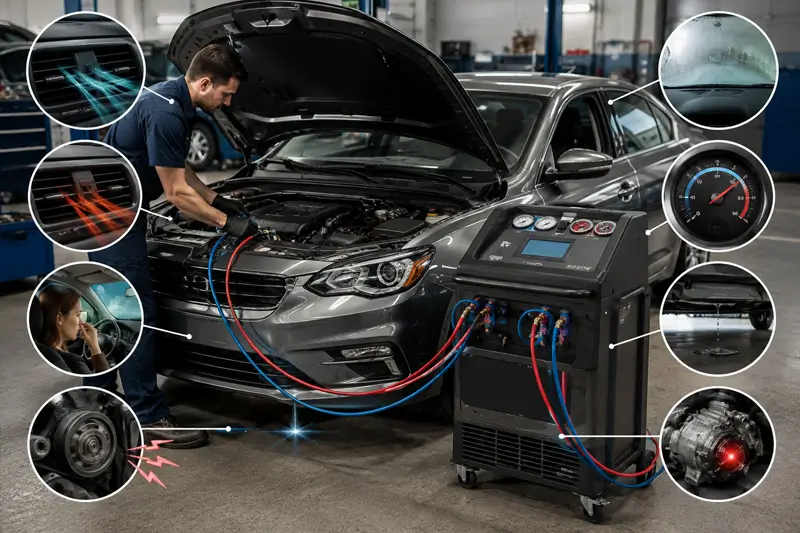
Most drivers don’t think about their car’s air conditioning until it stops being cold. By then, the cause is usually one of a short list of things, and which one you’ve got determines whether the fix is a $30 cabin filter or an $1,800 compressor.
Here are the eight most common signs something’s wrong, roughly in order of how often we see them, what each one usually means, and which ones you can leave for a few weeks versus which ones need attention now.
1. Air Is Cool, But Not Actually Cold
This is the most common complaint we get. Vent temperature on a hot day should sit around 5–8°C. If yours feels more like 12–15°C, cooling but not cold, the system is almost always low on refrigerant.
What it usually means: a slow leak. Refrigerant doesn’t get “used up” in a sealed system, so a gradual drop in performance over months means gas is escaping somewhere, not disappearing on its own.
Urgency: low. It won’t get worse quickly, but it won’t fix itself either, and the longer a system runs low on gas, the less oil circulates with it, which is what eventually damages the compressor.
2. AC Cycles On and Off Instead of Running Steadily
You’ll hear the compressor clutch engage and disengage every few seconds instead of running continuously. This is a step further along the same problem as symptom one.
What it usually means: system pressure has dropped enough that the compressor’s low-pressure switch is cutting it out to protect it. It’s the system protecting itself from running near-empty.
Urgency: moderate. Running a compressor repeatedly at the edge of its cut-out pressure accelerates wear on the clutch. Worth booking within a couple of weeks rather than months.
3. Musty or Sour Smell When the AC First Comes On
A smell that’s strongest in the first minute and fades isn’t a refrigerant issue at all.
What it usually means: mould growing on the evaporator core, almost always paired with a cabin filter that’s overdue for replacement. Warm, humid Brisbane air sitting in an AC system overnight is exactly the environment mould needs.
Urgency: low for the system, higher for comfort and allergies. A cabin filter swap and an evaporator sanitising treatment usually clears it, and it’s one of the cheapest items on this list.
4. Windows Fog Up More Than They Used To
Air conditioning does more than cool the cabin. It dehumidifies the air passing through it, which is why demisting a windscreen works faster with the AC on than heater alone.
What it usually means: if demisting has gotten noticeably slower, the system isn’t pulling moisture out of the air the way it should. Often paired with symptom one, since the same low-refrigerant condition reduces both cooling and dehumidifying.
Urgency: moderate. Beyond comfort, it’s a visibility issue on a wet Brisbane morning.
5. You’re Regassing Every Few Months
If a workshop has topped up your gas more than once in the past year, that’s not bad luck.
What it usually means: there is a leak, and it hasn’t been found. Refrigerant in a sealed system that has no leak lasts three to five years before it needs attention again. If yours needs it every few months, gas is leaving through a specific point, and simply adding more each time means paying for the same repair on a subscription.
Urgency: high, for your wallet if nothing else. We’ve covered exactly what a proper leak-finding process involves in how a car aircon regas actually works, including the vacuum test and UV dye step that pins down where the gas is going.
6. Water Pooling on the Passenger-Side Floor
Air conditioning produces condensation as a normal by-product, and that water is meant to drain outside the cabin through a small hose.
What it usually means: the drain is blocked, usually with leaf litter or built-up grime, and the condensation is backing up into the cabin instead of draining outside.
Urgency: moderate but time-sensitive. This is an easy, cheap fix if caught early. Left for a few weeks it soaks the carpet underlay, and wet carpet in a closed car is another mould problem, this time a much more expensive one to fix.
7. A Loud Squeal or Rattle When the AC Switches On
Unlike the symptoms above, this one is mechanical, not refrigerant-related, and it’s the one on this list worth acting on immediately.
What it usually means: the compressor clutch bearing is failing. The noise is the bearing complaining under load every time the clutch engages.
Urgency: high. A failing clutch bearing that’s ignored will eventually seize completely, and a seized compressor clutch can take the drive belt with it, which affects more than just your air conditioning. This is the one symptom on this list where waiting turns a moderate repair into a much bigger one.
8. AC Is Cold While Driving, but Warm at Idle or in Traffic
The least common symptom on this list, and the one most likely to be misdiagnosed as a simple regas.
What it usually means: the condenser fan isn’t running, or isn’t running fast enough, at low road speed. At highway speed, airflow through the grille cools the condenser regardless. Sitting still or crawling in traffic, the system relies entirely on the electric fan, and if that fan or its relay has failed, cooling drops off exactly when you notice it most.
Urgency: moderate to high. Refrigerant is often fine here, and a regas won’t fix it. This one needs an electrical diagnosis, not a top-up.
What Not to Do
If a workshop hears any of these symptoms and goes straight to “let’s regas it” without asking which symptom you’ve got or checking pressures first, that’s a guess, not a diagnosis. A regas fixes low refrigerant. It does nothing for a blocked drain, a failing clutch bearing, or a dead condenser fan, and paying for gas on top of one of those problems means paying twice.
Frequently Asked Questions
Can I keep driving if my AC is just weak, not off completely?
Yes, it won’t damage the car in the short term. But a system running low on refrigerant for months circulates less lubricating oil through the compressor, which is what eventually turns a cheap regas into an expensive compressor job. Weak is worth booking in, not urgent.
Will a regas fix all of these symptoms?
No, and that’s the main point of this list. Symptoms one, two, four and five are refrigerant-related and a proper regas addresses them. Symptoms three, six, seven and eight need a filter, a drain clear, a bearing, or an electrical check, not gas.
How often should I get my AC checked if nothing seems wrong yet?
Every two to three years, even if it’s still blowing cold. Refrigerant seeps out at a very low rate through hoses and seals over time, which is normal, and catching it early is always cheaper than catching it late.
Is the musty smell actually harmful?
It’s more of a comfort and allergy issue than a mechanical one. Mould spores from the evaporator get blown into the cabin every time the AC runs, which is unpleasant for anyone with allergies or asthma, but it’s not damaging the AC system itself.
Get It Checked, Not Just Regassed
If you’ve spotted one of these signs, book a proper inspection rather than a guess-and-fill. We check pressures, run the Ecotechnics ECK TWIN 12 service station’s full diagnostic cycle, and tell you which of these eight it actually is before quoting anything. Book online or call (07) 3279 3228. For current pricing, see our car AC repair and regas page.
Ultimate Car Expert, 4/4 Curragundi Rd, Jindalee QLD 4074. ARC Licence AU66890.