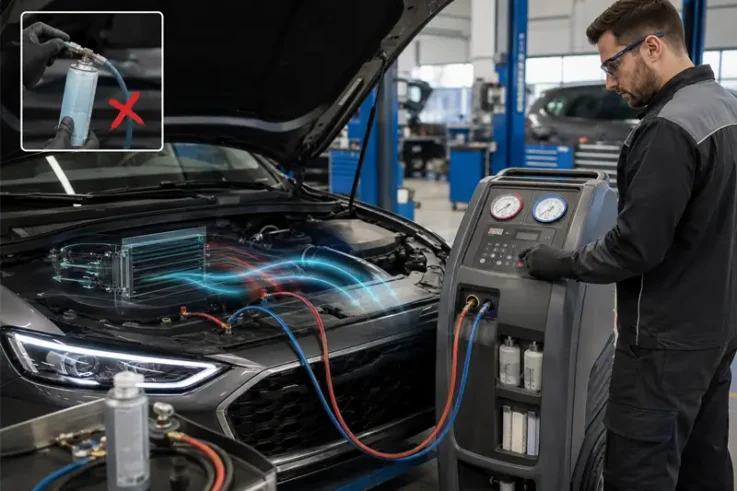

Ask five workshops what a car aircon regas involves and you’ll get five different answers. At the honest end, it’s a full diagnostic process: gas recovery, a vacuum test, a leak check, then a manufacturer-specified refill. At the other end, it’s someone connecting a cylinder to your low-pressure port and pumping in gas until the compressor stops cycling. Both get called a “regas.” Only one of them actually fixes anything.
Here’s what happens when we do it properly at our Ultimate Car Expert Jindalee workshop, using our automatic Ecotechnics AC machines, and why skipping any of these steps usually means you’re back in twelve months paying for the same job again.
Which Refrigerant Does Your Car Actually Use?
Before any gas goes in, you need to know which gas your car takes. R134a and R1234yf are not interchangeable, and mixing them damages the compressor.
R134a is the gas fitted to most vehicles built before around 2017. It’s the older refrigerant and the one most Australian workshops are already set up to handle.
R1234yf is the newer, lower global-warming-potential refrigerant. Manufacturers began fitting it to new vehicles from around 2017 onward, and uptake in Australia has been gradual rather than an overnight switch, so it’s worth checking rather than assuming. It’s also considerably more expensive than R134a per kilogram, and it needs its own dedicated recovery machine. That’s part of why some smaller workshops quietly avoid R1234yf jobs, or worse, run the wrong equipment on the wrong gas.
The refrigerant type is usually listed on a compliance sticker under the bonnet. If yours has worn off or was never clearly fitted, we check the vehicle against our machine’s database before touching the system, not after.
At our workshop we run separate, fully automatic Ecotechnics machines for R134a and R1234yf, so there’s no cross-contamination risk and no guesswork on which gas goes in.
What Actually Happens During the Service
Step 1: Full Gas Recovery First
Before anything is added, the machine recovers whatever refrigerant is currently in the system and weighs it as it comes out. Two things happen here that a “top-up” service skips entirely.
First, we find out exactly how much gas was in there. Say the manufacturer specifies 500g and only 310g comes out. That’s close to a 40 percent loss, and it tells us there’s a leak somewhere, not just normal ageing.
Second, recovering the old gas before adding new gas means we’re never mixing a partial old charge with a fresh one. Topping up on top of old refrigerant means nobody actually knows what’s in the system or how much oil is circulating with it, which is one of the most common reasons a quick regas from a mobile operator doesn’t last.
Recovered gas is stored and recycled through the machine rather than vented to atmosphere. That’s a legal requirement under Australian refrigerant handling regulations, not an optional extra.
Step 2: The Machine Checks the Manufacturer’s Spec, Not a Guess
Every vehicle has an exact refrigerant charge weight and oil specification set by the manufacturer. The Ecotechnics database looks up the specific make, model and year and pulls the correct figures automatically, rather than a technician estimating “about a can and a half.”
Overcharging a system is one of the more common causes of poor cooling and unnecessary compressor wear, and it happens more often than most drivers would guess when a workshop fills by feel instead of by spec.
Step 3: Vacuum and Leak Test Before Any Gas Goes Back In
Once the old gas is out, the system is pulled down to a deep vacuum. This does two jobs at once. It removes any moisture that’s found its way into the system, which matters because moisture turns into acid and corrodes components from the inside over years. And it acts as a leak test in its own right: if the system can’t hold vacuum, there’s a leak, and we know that before a single gram of new refrigerant is wasted.
Skipping this step is the single biggest reason a “regas” doesn’t last. Refill a leaking system without testing it first, and the gas you paid for is gone again within weeks.
Step 4: UV Dye and Physical Leak Inspection
If the system has lost a meaningful amount of gas, we add UV tracer dye during the recharge, then physically inspect the hoses, condenser, compressor shaft seal, evaporator and every pipe connection under UV light.
Small leaks at an O-ring or a fitting are usually around a $200 fix. Left unfound and undiagnosed, the same leak eventually starves the compressor of lubrication and turns into an $850 to $1,800 job.
This is the step that quick, cheap regas advertising tends to skip, because it takes time and the dye needs a day or two to circulate fully. It’s also the difference between fixing the actual problem and paying for the same regas again next winter.
Step 5: Recharge to the Exact Spec, Then Performance Test
Once the system holds vacuum and any leaks are repaired, the machine recharges to the exact manufacturer-specified weight of gas and oil. We then run a performance test, checking vent temperature at idle and again after several minutes of running, to confirm the system is actually delivering cold air rather than just holding pressure on a gauge.
Why This Matters More Than It Sounds
A system holding the wrong charge, over or under spec, doesn’t just blow warmer air. It puts uneven load on the compressor, which is the most expensive single part in the system to replace. A proper regas now, typically $199 to $450 depending on gas type, is cheap insurance against an $850-plus compressor replacement down the track, and the difference usually comes down to whether the workshop tested for a leak before adding gas, or waited until you complained a second time.
If your air conditioning needs a regas every few months, that’s not bad luck. That’s an unfound leak, and refilling it again without finding the source is paying for the same repair on a subscription.
Frequently Asked Questions
Does R1234yf cost more to regas than R134a?
Yes, noticeably. The gas itself is more expensive per kilogram, and the recovery and recharge equipment for it is a separate, dedicated machine. That’s reflected in the price difference between the two services.
Can a workshop use R134a equipment on an R1234yf system, or the other way round?
No. The gases aren’t compatible, and the service fittings are different sizes specifically to prevent cross-connection. Mixing them, or running the wrong machine on the wrong gas, risks serious compressor damage. If a workshop can’t tell you which dedicated machine they’re using for your gas type, that’s worth asking before you book.
Is UV dye safe for my car’s AC system?
Yes. It’s a small, oil-soluble additive designed for automotive AC systems, and it circulates with the refrigerant oil without affecting cooling performance. It also stays in the system afterwards, which makes any future leak faster to trace.
How do I know if I need a regas or if there’s a leak?
If your AC has gradually gone from cold to lukewarm over months, that usually points to a slow leak rather than a sudden fault. If it stopped being cold with no warning, that’s more likely a sudden leak or a component failure. Either way, the vacuum and leak test in a proper regas tells us which one you’re dealing with rather than guessing.
Do you regas both gas types at the Jindalee workshop?
Yes. We run separate automatic machines for R134a and R1234yf, so we can service either gas type without cross-contamination risk, and we check your vehicle’s compliance sticker against the database before we start.
Book a Proper Regas, Not a Top-Up
If your car’s air conditioning is due for a service, or you’re on your second or third regas in as many years, it’s worth having it done properly once. Book an AC inspection online or call the workshop on (07) 3279 3228. For current regas pricing and the full repair process, see our car AC repair and regas page.
Ultimate Car Expert, 4/4 Curragundi Rd, Jindalee QLD 4074. ARC Licence AU66890.


