Wheel Alignment in Brisbane — Jindalee Workshop
Bad wheel alignment destroys new tyres within 10,000 km. It also makes the car pull to one side, wear the steering wheel off-centre, and feel vague through corners. Ultimate Car Expert does digital four-wheel alignment at our Jindalee workshop with before-and-after printouts so you can see exactly what changed.
Wheel alignment pricing
- Standard four-wheel alignment (passenger car, SUV up to 4.5 tonnes) — from $129
- 4WD / dual-cab ute (Hilux, Ranger, Prado, Landcruiser) — from $149
- Lifted 4WD (after lift kit installation) — from $189
- Front-only alignment (solid rear axle vehicles) — from $89
- Alignment check only (diagnostic, no adjustment) — $49
All alignments come with a printed before-and-after sheet showing your measurements against the manufacturer’s specifications.
When you need an alignment
- After new tyres are fitted: Fitting new rubber to a car with incorrect alignment wears them out fast. We include an alignment check free with a set of four tyres.
- After hitting a kerb or pothole hard: Impact knocks the alignment out of spec. If you hit something and the steering feels different afterwards, get it checked.
- After suspension work: Any time a tie rod, control arm, strut, or wheel bearing is replaced, the alignment needs to be reset.
- When the car pulls to one side on a level road: Usually a camber or caster issue.
- When the steering wheel is off-centre when driving straight: Toe adjustment needed.
- When tyres wear unevenly: Inside edge worn is typically too much negative camber or excessive toe-out. Outside edge worn is the opposite. Feathered wear (smooth on one side of each tread block, sharp on the other) is a toe problem.
- Every two years as preventative maintenance: Alignment drifts slightly over time from normal use. A check every couple of years catches small issues before they destroy tyres.
What actually gets adjusted
A proper four-wheel alignment adjusts three angles per wheel:
- Toe: How parallel the wheels are to each other. Too much toe-in (pointing together) or toe-out (pointing apart) causes rapid tyre wear.
- Camber: The tilt of the top of the wheel in or out relative to vertical. Incorrect camber wears the inside or outside edge of the tyre.
- Caster: The tilt of the steering axis forward or backward. Affects steering feel and straight-line stability. Usually not adjustable on modern cars unless the car has been in an accident.
On cars with rear adjustment (most modern vehicles), all four wheels are aligned. On solid rear axle vehicles (older utes, some commercial vans), only the front is adjustable.
The alignment process
- Pre-alignment check: We check for worn suspension and steering components. Alignment on a car with worn tie rods or ball joints is a waste of money — the geometry won’t stay in spec. If we find worn parts, we recommend fixing them first.
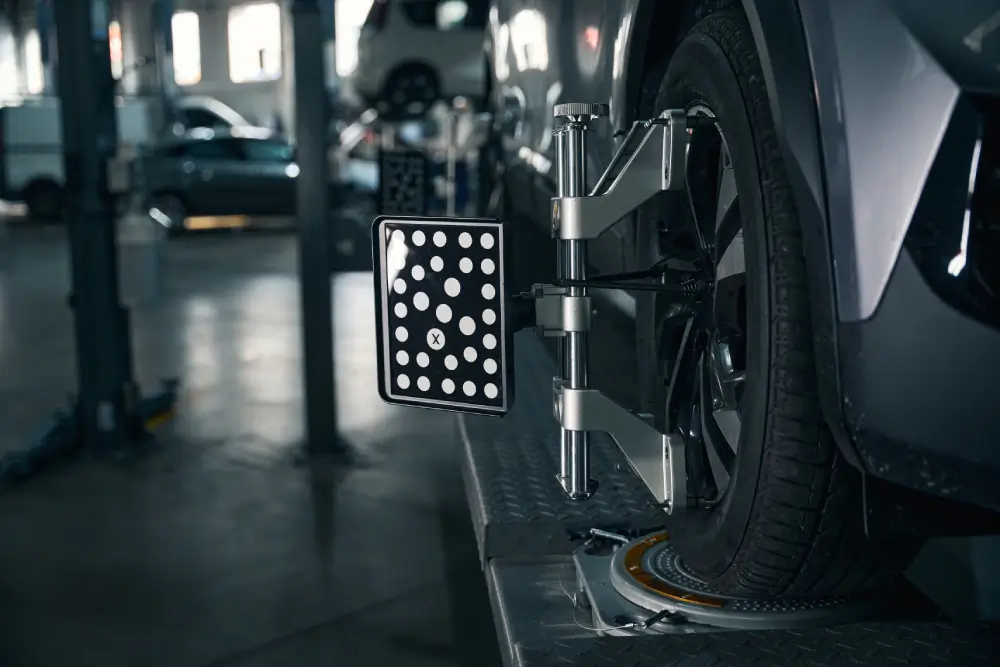
- Hoist and attach sensors: Digital sensors clamp to each wheel and communicate with the alignment computer.
- Measure: Current alignment values are compared against the manufacturer’s specification for your exact vehicle.
- Adjust: Toe, camber (where adjustable), and caster (where adjustable) are set to the centre of the spec range.
- Verify: Re-measure and confirm all values are within tolerance.
- Test drive: Short road test to confirm the car tracks straight and the steering wheel is centred.
- Print the report: You get a physical printout showing the before and after numbers for every angle, every wheel.
Why four-wheel alignment beats front-only
Older workshops do “two-wheel” or “front-only” alignment. This is fine on vehicles with solid rear axles, but useless on most modern cars which have independent rear suspension that can be out of spec.
A car with correctly-aligned front wheels but rear wheels out of spec will still wear tyres unevenly and handle oddly. The rear wheels set the thrust line — if that’s off, the front wheels compensate and wear incorrectly.
We do full four-wheel alignment on everything except vehicles that genuinely don’t have rear adjustment.
Common causes of alignment going out
- Kerb impact (parking, tight corners)
- Pothole or expansion joint at speed
- Accident damage (even minor)
- Worn suspension components (bushes, ball joints, tie rod ends)
- Lowering or lifting the car without re-aligning
- Fitting heavier tyres or different wheel offsets
- General age and use (bushes and components wear)
The "car pulling to one side" diagnosis
Not every pull is alignment. Quick checks we do before adjusting anything:
- Tyre pressure: Unequal pressure left to right will pull the car. Quick fix.
- Tyre wear or type: Mismatched tyres pull. Worn tyres pull.
- Brake drag: A sticky caliper creates drag on one side. Feels like alignment pull.
- Steering rack bushes: Worn bushes let the rack shift under load, mimicking alignment issues.
If the pull is from one of these rather than alignment, adjusting alignment is fixing the wrong problem.
Alignment after lift kit or lowering kit
Changing the ride height changes all the suspension angles. A 2-inch lift on a Prado changes caster, camber, and toe. A lowering kit on a sedan does the same. Alignment after any height change is not optional.
Some lift kits require additional components (adjustable upper control arms, caster correction bushes) to get alignment back into spec. We advise before the lift is fitted, not after.
Why the printout matters
Some workshops charge for an alignment and show you nothing. You have no way to know whether the alignment was actually done, or done correctly. Our printed report shows every angle before, every angle after, and the manufacturer’s spec range. You see what you paid for.
Areas we serve
Jindalee, Mount Ommaney, Middle Park, Sinnamon Park, Jamboree Heights, Westlake, Riverhills, Forest Lake, Oxley, Corinda, Sherwood, Indooroopilly, Taringa, Kenmore, Chapel Hill, Fig Tree Pocket, Brookfield, Bellbowrie, Moggill, Toowong and surrounding suburbs.
Frequently Asked Questions
How long does alignment take?
45 minutes to an hour for most vehicles. Longer for 4WDs with lifts where adjustments are limited and require additional work.
How often should I get an alignment?
Every 20,000 km as a preventative measure, or whenever you notice pulling, off-centre steering, or uneven tyre wear.
Will alignment fix my vibration at highway speed?
No. Vibration at speed is wheel balancing, not alignment. We balance and align on the same visit if needed.
Does alignment fix worn tyres?
No. It stops them wearing further unevenly, but existing uneven wear is permanent. If tyres are badly worn on one edge, alignment plus new tyres is usually the right answer.
Can I feel the difference after alignment?
Yes, especially on cars that were significantly out of spec. Steering feels lighter, the wheel sits straight, and the car tracks better on the highway.