
Radiator Repair in Brisbane — Jindalee Workshop
An overheating engine in Brisbane traffic is the fastest way to destroy an otherwise healthy car. Ignore the temperature gauge for 60 seconds in summer and you can warp the cylinder head or blow the head gasket — a $200 radiator hose becomes a $4,000 engine repair. Ultimate Car Expert does radiator and cooling system repair at our Jindalee workshop, from hose replacement to full radiator swap.
Radiator and cooling system pricing
- Radiator replacement (standard car). From $549 fitted. Includes new radiator, coolant, and hoses where required.
- Radiator replacement (4WD, ute, diesel). From $749 fitted.
- Radiator replacement (European, prestige). From $889 fitted.
- Thermostat replacement. From $249 fitted.
- Water pump replacement. From $389 fitted. If the water pump is driven by the timing belt, done as part of the timing belt job for significantly less than as a standalone repair.
- Coolant hose replacement (upper or lower). From $149 fitted per hose.
- Full cooling system flush. From $189. Recommended every 60,000 km or 4 years.
- Coolant top-up and pressure test. From $89.
- Fan or fan motor replacement. From $289 to $649 fitted depending on vehicle.
- Fan clutch replacement (older 4WDs). From $289 fitted.
- Heater core repair or replacement. From $589 to $1,400 depending on how buried the heater core is (sometimes the whole dash comes out).
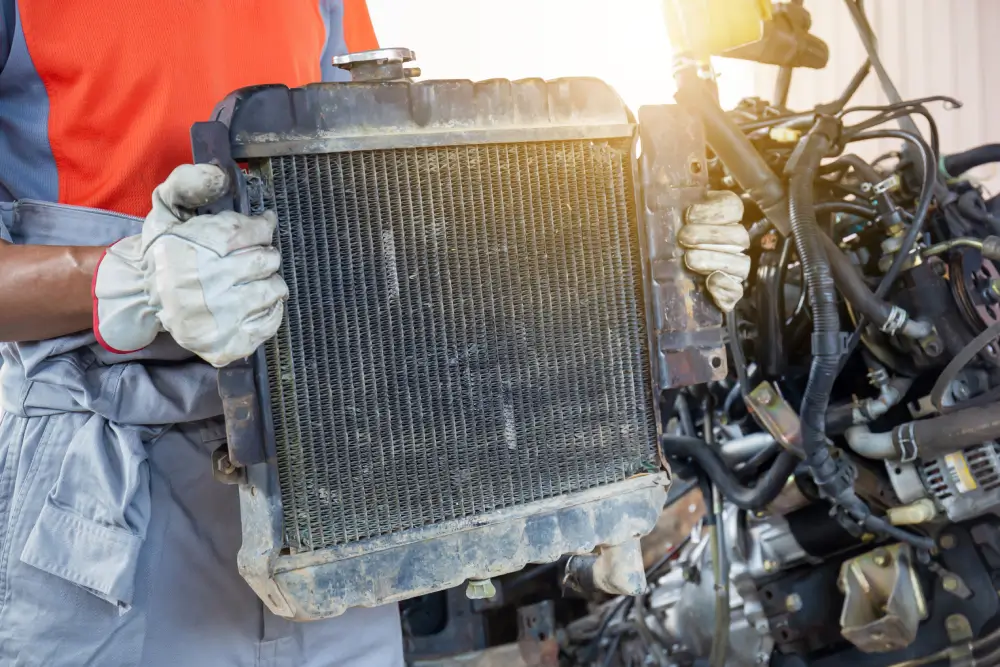
Signs your cooling system needs attention
- Temperature gauge rising above normal. Your car has a normal operating range — usually one-third to halfway up the gauge. Anything consistently above halfway is hot. Anything in the red is stop-the-car hot.
- Coolant visible on the ground. Green, orange, pink, or yellow fluid depending on brand. Find where it’s leaking from before it runs dry.
- Sweet smell inside the cabin. Heater core leaking coolant into the cabin. Needs attention before the cabin floor gets soaked.
- White steam from under the bonnet. Boiling coolant or external coolant leak hitting a hot surface. Stop the car, let it cool, investigate. Do not open the radiator cap while hot — pressurised hot coolant will scald you.
- White smoke from the exhaust. Coolant entering the combustion chamber — head gasket issue usually. Serious.
- Milky or frothy oil under the oil filler cap. Coolant mixing with oil. Head gasket or internal coolant leak.
- Heater blows cold when set to hot. Usually a stuck-open thermostat (engine runs cold and heater can’t warm up) or a blocked heater core.
- Coolant level dropping with no visible leak. Internal leak — head gasket or coolant being burned in the combustion chamber.
- Puddle of coolant only when car is parked. External leak. Track where on the ground the puddle forms relative to the car — front is usually radiator or hoses, middle is usually water pump or thermostat housing.
How a cooling system works
Brief version: the water pump circulates coolant through the engine, picking up heat. The heated coolant flows to the radiator, where the fan pulls air through it and transfers heat to atmosphere. The thermostat controls flow — closed when the engine is cold (for faster warm-up), open once at operating temperature.
Components that fail: hoses (age and crack), radiator (corrosion and leaks), water pump (bearing failure), thermostat (stuck open or stuck closed), coolant (loses protective additives over time), fans (motor failure or clutch failure).
Get one wrong and the engine overheats. That’s why diagnosis matters.
The proper diagnostic approach
- Pressure test the system. Pump the cooling system to 15 psi and look for leaks. External leaks become obvious immediately. Pressure drop with no visible leak indicates an internal leak (head gasket).
- Test the thermostat. Remove it, heat it in water, watch it open at the spec temperature. Or infer from engine behaviour (thermostat stuck closed = engine runs hot; stuck open = engine runs cold).
- Inspect the radiator. External fins crushed or corroded, leaking seams, plastic end-tank cracked. All common failures.
- Test the radiator cap. A weak cap won’t hold pressure. The system’s designed to run at 1 to 1.4 bar above atmospheric — at that pressure, coolant boils at 125°C instead of 100°C. A failed cap lets the coolant boil early.
- Check the fan. Engine to operating temperature, confirm the fan engages when the coolant reaches cut-in temperature. A fan that doesn’t engage causes overheating at idle (while highway driving is fine because airflow through the radiator is adequate).
- Chemical test for combustion gases in coolant. Confirms or rules out head gasket involvement.
Coolant — not all the same
Different manufacturers use different coolant chemistries. Mixing them causes reactions that produce sludge, block passages, and destroy water pumps.
- Green / conventional (IAT). Older Japanese, Korean, and American cars.
- Orange / extended life (OAT). Many modern cars — GM, Ford, some Europeans.
- Pink / HOAT. Chrysler, Mercedes-Benz, some Mazda.
- Blue. Toyota-specific, similar to HOAT.
- Yellow. BMW, VW, some Audi.
Mixing these is bad. We use the exact coolant specification the manufacturer requires. We don’t top up an unknown system with generic green — we flush and refill with the correct fluid if there’s any doubt.
Overheating — what to do in real time
If the temperature gauge starts rising in traffic:
- Turn off the air conditioning. AC adds heat load to the engine. Turning it off reduces that load immediately.
- Turn on the heater to maximum hot and fan maximum. The heater core is a secondary radiator. Running it pulls heat out of the coolant. Uncomfortable on a hot day but it buys you time.
- Pull over if safe. Turn the engine off. Heat can’t keep building if it’s not running.
- Wait 30 to 45 minutes before opening the bonnet. Or better yet, wait for a tow.
- Do not add cold water to a hot engine. Thermal shock cracks heads and blocks.
- Do not open the radiator cap while hot. Pressurised hot coolant ejects violently and causes serious burns.
Continuing to drive an overheating engine warps the head in under a minute. A tow truck is cheaper than a head gasket.
Areas we serve
Jindalee, Mount Ommaney, Middle Park, Sinnamon Park, Jamboree Heights, Westlake, Forest Lake, Oxley, Corinda, Sherwood, Indooroopilly, Taringa, Kenmore, Chapel Hill, Fig Tree Pocket, Brookfield, Bellbowrie, Moggill, Toowong and all surrounding suburbs.
Frequently Asked Questions
How often should coolant be changed?
Every 4 to 5 years or 60,000 km for most cars. Some modern “lifetime” coolants claim 10 years — we flush at 5 years anyway in Brisbane’s heat.
Can I drive home with my car overheating?
No. Every minute of overheating causes damage. Pull over, let it cool, get a tow.
How long does radiator replacement take?
Most cars: 3 to 4 hours. Some tightly-packaged vehicles (Commodore V8, some Europeans): half a day.
Why is my coolant disappearing but I can't see a leak?
Either an internal leak (head gasket) or a slow external leak that evaporates before pooling. Pressure test finds both.
What's the difference between coolant and antifreeze?
In Australia, “coolant” usually refers to the pre-mixed product (coolant plus water plus additives) sold in bottles. “Antifreeze” is the concentrated additive. Same chemistry, different dilution.