
Head Gasket Repair in Brisbane — Jindalee Workshop
A blown head gasket is one of the few car problems that can genuinely be a write-off. Not because the repair is impossible, but because the cost can approach the value of the car. Ultimate Car Expert diagnoses head gasket failure properly at our Jindalee workshop, and we give you honest numbers so you can decide whether repair is worth it.
Head Gasket Repair Brisbane work is our senior technician’s specialty. Done properly, a repaired engine can run another 200,000 km. Done badly, the repair fails again within 12 months.
Head gasket repair pricing
- Standard 4-cylinder petrol engine (Corolla, Mazda3, i30 etc). From $2,200 fitted. Includes gasket kit, new head bolts, coolant, oil, engine gaskets disturbed during disassembly, plus labour.
- V6 petrol engine (Camry, Magna, Commodore, Falcon, Territory). From $3,200 fitted.
- V8 engine (Commodore SS, Landcruiser, Jeep). From $4,200 fitted.
- 4-cylinder diesel (Hilux, Ranger, Triton, D-Max). From $3,400 fitted.
- European petrol (BMW, Audi, VW). From $3,600 fitted.
- Turbo or performance engines. Add $400 to $900 for additional complexity.
- Head machining (if required). $200 to $450. We send the head to a specialist machine shop for pressure test, crack test, and decking flat.
- Head replacement (if cracked beyond repair). $800 to $2,400 for a quality reconditioned cylinder head. Sometimes genuine new if available.
All pricing includes head removal, inspection, reassembly with correct torque procedure, and refilling all fluids.
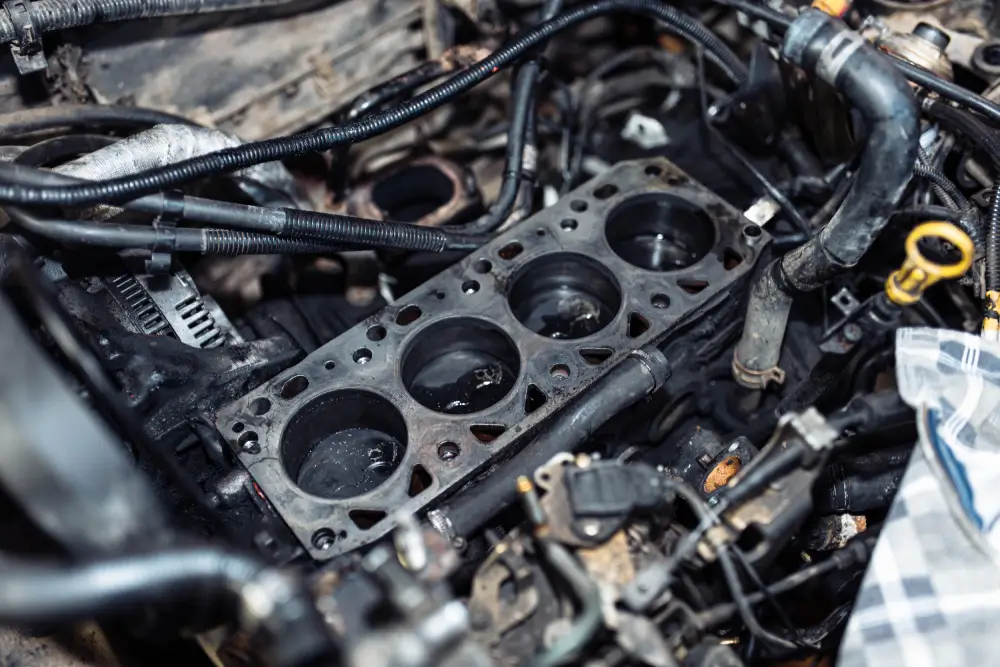
Is it actually a head gasket — or something else
Head gasket symptoms overlap with a bunch of other engine problems. Proper diagnosis matters because the “fix” for each is different.
Looks like head gasket but might not be:
- Overheating from a bad water pump or thermostat
- Oil leak from a rocker cover gasket (external)
- Coolant leak from a hose, thermostat housing, or water pump
- White smoke from a cold start that clears after 2 minutes (normal on cold humid mornings)
- Rough running from spark plugs, coils, or injectors
Head gasket symptoms overlap with a bunch of other engine problems. Proper diagnosis matters because the “fix” for each is different.
Real head gasket symptoms:
- Coolant loss with no external leak. Pressure test confirms no external leak; coolant still disappearing means it’s going somewhere internal.
- White smoke from exhaust that smells sweet. Coolant burning in the combustion chamber.
- Milky residue under oil filler cap or on dipstick. Coolant mixing with oil in the crankcase.
- Bubbles in the coolant overflow tank when engine is hot. Combustion gases entering the cooling system.
- Persistent overheating even with good cooling system. Head gasket leaking hot combustion gas into coolant.
- Spark plug with coolant residue on the tip. Coolant leaking directly into one cylinder.
Definitive test — chemical combustion gas test. Sample of gas from above the coolant tested for hydrocarbons. Positive result confirms head gasket. Negative result means look elsewhere.
Why head gaskets fail
- Overheating. Most common cause. An engine run hot warps the cylinder head; warped head no longer seals to block; gasket fails.
- Age and thermal cycling. Over hundreds of thousands of km, the gasket material fatigues from expansion and contraction.
- Pre-ignition or detonation. Combustion happening at the wrong time spikes cylinder pressure beyond design spec.
- Known weaknesses on specific engines. Some engines are known for head gasket failure — Subaru EJ25, BMW N54/N55, Mini Cooper, older Ford Duratec, some Toyota 2.2 diesels. Brand and model matter.
- Poor previous repair. Head gasket replaced without proper head skimming, or with wrong torque sequence, or with reused head bolts — these fail within 12 months.
What a proper head gasket repair involves
- Full diagnostic confirmation. Pressure test, chemical test, compression test. We don’t tear an engine down on suspicion.
- Engine preparation. Drain coolant, remove intake manifold, exhaust manifold, fuel rail, spark plugs, cam cover, timing belt or chain components.
- Head removal. Head bolts out in reverse torque sequence. Head lifted off carefully (heavy, awkward).
- Inspection. Head deck and block deck checked for flatness with a precision straight edge and feeler gauges. Any warp above spec (usually 0.05 mm) means machining.
- Machining if needed. Head goes to a machine shop. Pressure test to confirm no cracks. Deck skim to return flatness. Valves inspected, sometimes lapped or replaced.
- Cleaning. Block deck cleaned of old gasket material without scratching. Oil passages cleaned. Coolant passages cleaned. This step is critical — a contaminated deck or bolt hole causes uneven torque, which causes failure.
- Reassembly. New head gasket (brand matters — OEM or proven aftermarket like Cometic, Victor Reinz, Elring). New head bolts always (torque-to-yield bolts cannot be reused). Correct torque sequence, correct angle-tightening procedure per manufacturer.
- Timing reassembly. Timing belt or chain reset precisely. Tensioners, seals.
- Final reassembly. All removed components refitted. All fluids refilled.
- Start and run. Extended warm-up with monitoring. Re-check for leaks. Road test.
Total labour: 12 to 20 hours for most engines. More for complex layouts.
When we recommend against repair
Sometimes the numbers don’t work. We tell you honestly:
- Car worth $4,000, head gasket cost $2,800. Repair cost is 70 percent of the car’s value. Risky investment — if anything else fails in the next 12 months, you lose both.
- Engine has existing major wear. Compression test shows the pistons and rings are tired. A new head gasket on a tired bottom end means repairing the top and leaving the bottom waiting to fail. Better to consider a replacement engine.
- Head is beyond machining. Warped too far, cracked in multiple places, valve seats damaged. Sometimes a replacement head is cheaper than repair, sometimes an entire replacement engine is the right call.
- Ownership plans. If you plan to sell within 12 months, the repair might not return its cost in resale value. A disclosed repair reduces a car’s saleable value regardless of the quality of the work.
Cooling system work during a head gasket job
We always inspect the cooling system thoroughly during a head gasket repair because:
- A head gasket failure is often caused by cooling system problems.
- Fixing the gasket without fixing the cause means the gasket fails again.
- Labour to replace thermostats, water pumps, and hoses is minimal while the top end is already apart.
We discuss recommendations before the work and make sure the price includes what’s needed to prevent a repeat failure.
Areas we serve
Jindalee, Mount Ommaney, Middle Park, Sinnamon Park, Jamboree Heights, Westlake, Forest Lake, Oxley, Corinda, Sherwood, Indooroopilly, Taringa, Kenmore, Chapel Hill, Fig Tree Pocket, Brookfield, Bellbowrie, Moggill, Toowong and all surrounding suburbs.
Frequently Asked Questions
Can I drive my car with a blown head gasket?
Very short distances only. Every minute of running causes more damage — coolant in oil destroys bearings, overheating warps the head further. Get it to a workshop, don’t keep driving.
How long does a head gasket repair take?
Typically 3 to 5 working days, including time for head machining at a specialist shop. Some cars can be done faster; European engines often take longer.
Will a head gasket repair last?
Yes, done properly. 200,000 km or more is normal on a correctly-repaired engine. Done badly, they fail in months — which is why diagnosis, machining, and correct torque procedure all matter.
Can I use head gasket sealer in a bottle?
No. Products like “head gasket seal” block small leaks in cooling systems by depositing material in narrow passages. On a head gasket failure, they either do nothing or block the whole cooling system. Waste of money at best, engine-destroying at worst.
Do you warranty head gasket work?
Yes. 12 months or 20,000 km on the workmanship. The head gasket itself comes with manufacturer warranty (usually 12 to 24 months).