
Car Aircon Regas in Brisbane — From $199 at Jindalee
Car aircon regas is one of the most commonly overpriced jobs in the automotive industry. Some workshops charge $600 for a regas that costs $200 elsewhere; others charge $99 and don’t actually do the work properly. Ultimate Car Expert is an ARC-licensed AC workshop (licence AU66890), which means we have the equipment and certification to do the job legally and correctly — and we charge a fair price for it.
This page is specifically about regas. For full AC diagnosis and repair (leaks, compressor failure, components not cooling), see our car AC repair page.
Aircon regas pricing
- Standard regas (R134a — most cars pre-2017). From $199.
- Regas with R1234yf (post-2017 cars, most modern vehicles). From $329.
- Regas with leak test. Add $89 if needed. Recommended if your AC has lost gas recently with no known repair.
- Full AC service and performance test. From $249. Includes regas, cabin filter check, compressor engagement check, vent temperature measurement, compressor oil level check.
- Vent temperature check only. $49. We check before we recommend a regas — sometimes the AC is fine and the problem is elsewhere.
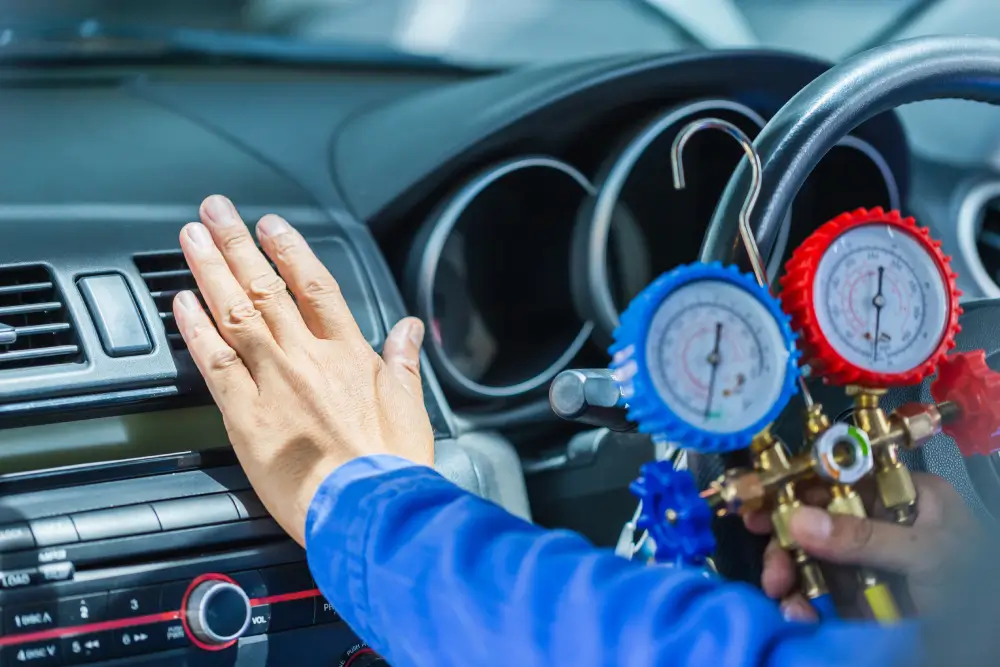
What a proper regas involves
A regas is not “put gas in the car.” It’s:
- Connect gauge manifold to the high and low service ports. Reads current system pressure, tells us whether the system is empty, low, or full.
- Recover existing refrigerant. The remaining gas in the system is pumped out by a recovery machine, measured, and stored for recycling. Releasing refrigerant to the atmosphere is illegal in Australia — we can’t do it even if we wanted to.
- Vacuum the system. The system is pumped down to deep vacuum (around 500 microns of mercury or lower) using a quality vacuum pump. This removes every last trace of moisture and air.
- Hold the vacuum. Vacuum held for 15 to 30 minutes. If the vacuum bleeds up during this time, there’s a leak. We find and fix it before putting new gas in.
- Recharge with exact spec. The manufacturer specifies an exact gas weight for the system (usually 350g to 700g depending on the car). We weigh the gas in — not “eyeball it” — to hit the spec exactly.
- Add compressor oil if needed. Oil circulates with the refrigerant to lubricate the compressor. If the system has been low on gas for a long time, it’s often low on oil too. We top up to spec.
- Performance test. With the car running and AC on maximum, we measure vent temperature at idle and at 2,000 rpm after 5 minutes. Healthy systems hit 5 to 8°C at the vent on a normal day.
Total time: 60 to 90 minutes for a straight regas with no leak detection.
R134a vs R1234yf — the difference matters
R134a: The refrigerant used in cars built from the mid-1990s until around 2017. Still widely available. Cheaper ($40 to $80 per kilogram bulk).
R1234yf: The replacement refrigerant for cars built from 2017 onward. More environmentally friendly (lower global warming potential) but significantly more expensive ($350 to $600 per kilogram bulk). The equipment to handle it legally is also more expensive.
Your car will have a sticker under the bonnet stating which refrigerant to use. Mixing them damages compressors. Putting R134a in a car that requires R1234yf, or vice versa, is incompetent — we check the sticker before touching the car.
Some workshops advertise “$99 regas” and then either charge for R1234yf as a surprise upcharge at collection, or put R134a into an R1234yf system without telling you (damaging the AC system). Both are problems. Our quoted price is the price you pay, and the gas in your car is the gas your car was designed to use.
How often to regas
Refrigerant seeps out slowly through hoses, seals, and the compressor shaft seal at a natural rate. This is normal. Typical rate:
- Healthy AC system: loses 10 to 15 percent of gas over 2 to 3 years
- Older or hotter-climate cars: slightly faster
Recommended interval for a regas and system check: every 2 to 3 years.
If your AC needs regassing every 6 to 12 months, you have a leak that needs finding. Topping up a leaking system is a waste of gas — it ends up in the atmosphere and you end up paying again soon. A leak test is $89 added to the regas price and finds the problem.
When regas alone doesn't fix the AC
If your AC is completely empty of gas, something caused that. Sometimes it’s just slow seepage over many years (normal, regas fixes it). Sometimes it’s a failed component — a leaking condenser, a failed hose, a compressor shaft seal that’s let go. In that case, regassing without fixing the leak means the gas is gone again in weeks.
Our process:
- Check system pressure.
- If system is low but not empty, regas and retest in 3 months.
- If system is empty, recommend leak test first. Find the leak. Quote the repair. Then regas after repair.
We don’t charge you twice for the same problem.
Signs you need a regas
- Air is cool but not properly cold. Vent temperature should be 5 to 8°C. Anything above 12°C suggests low gas.
- AC was cold, now it’s not. Classic low-gas symptom.
- AC takes longer to cool the cabin than it used to. Gradual gas loss over time.
- Compressor cycles rapidly on and off. Low gas pressure triggering protection cut-outs.
- AC works fine at highway speed but not at idle. Borderline gas level plus weakening condenser airflow at low speed.
Signs you do NOT need a regas
- AC blows warm air with fan running at full speed. Usually electrical (clutch not engaging), not gas. Diagnosis first.
- AC blows cold from some vents, warm from others. Blend door problem in the dash, not refrigerant.
- AC blows cold at first, warm after 15 minutes. Icing up on the evaporator because of a blocked drain or cabin filter — not gas.
- Air from vents is strong but just warm. Compressor not running at all. Electrical or mechanical, not gas.
We diagnose before we sell you anything.
Areas we serve
Jindalee, Mount Ommaney, Middle Park, Sinnamon Park, Jamboree Heights, Westlake, Riverhills, Sumner, Forest Lake, Oxley, Corinda, Sherwood, Indooroopilly, Taringa, Kenmore, Chapel Hill, Fig Tree Pocket, Brookfield, Bellbowrie, Moggill, Toowong, Auchenflower, Milton, Paddington and all surrounding suburbs.
Frequently Asked Questions
How long does a regas take?
60 to 90 minutes for a regas with no issues. Longer if we need to leak-test first.
Will a regas fix my AC?
If the AC is working but not cold enough, yes. If the AC isn’t working at all, the problem is usually electrical or a failed component — regas alone won’t fix it.
My car is 2018. Which gas does it take?
Check the sticker under the bonnet. Most cars from 2017-2018 onward use R1234yf, but there are exceptions. The price depends on which.
Why is the R1234yf price so much higher?
Because the gas itself costs around 7 to 10 times what R134a costs per kilogram, and the equipment to handle it is considerably more expensive. We charge fairly for the actual cost.
Can you do a regas in my driveway?
No, a proper regas needs the vacuum pump and recovery machine. We do it at our Jindalee workshop.